
6 min read
Rail vehicles are long-distance runners, literally and figuratively. Locomotives, multiple units, trams and freight wagons are designed for a service life of several decades. Over that time they are serviced, overhauled, modernised and supplied with spare parts again and again.
The problem: many of the components inside a train have a much shorter life cycle than the vehicle itself. This article shows the challenges this creates for manufacturers, operators and maintenance depots.
Why rail is a special case
Long service life
A rail vehicle often stays in service longer than an engineer’s career. Throughout that time, spare parts supply must be secured, even when the original suppliers have long since moved on to other products.
Approval and safety
Rail vehicles are subject to strict approval requirements. Safety-relevant components, for example in the brakes, running gear or train protection, may only be replaced with approved parts. A change can require a new assessment.
Fire protection
In Europe, materials in rail vehicles are subject to the fire protection requirements of the EN 45545 series of standards. Cables, plastics, seals and insulating materials must be classified accordingly. A technically equivalent industrial part is therefore not automatically suitable for use in the vehicle.
Documentation and traceability
Whoever is responsible for maintaining a vehicle must be able to prove which parts were installed and when. The origin, conformity and inspections of the spare parts play an important role in this.
With rail vehicles, it is not enough for a part to fit. It also has to be approved, documented and traceable.
Where obsolescence strikes
The mechanics of a train, meaning the car body, bogies and wheelsets, are serviced and overhauled over its service life. The biggest spare parts problems arise elsewhere:
- Power electronics: Traction converters and auxiliary converters contain semiconductors and assemblies with short product cycles.
- Control and train management systems: Vehicle controllers, bus systems and displays quickly become technically outdated.
- Comfort and auxiliary systems: Air conditioning, door controls, passenger information, lighting.
- Industrial bought-in components: Fans, contactors, relays, sensors, power supplies, pneumatic valves, bearings.
The last group in particular is often underestimated. Many of these parts come from a supplier’s general industrial catalogue. When that supplier changes its range, the part disappears, even though the vehicle manufacturer still lists it in its bill of materials.
Who is responsible?
Spare parts supply for rail vehicles is spread across several players:
| Player | Role |
|---|---|
| Vehicle manufacturer | supplies spare parts, often via service contracts, responsible for design and approval |
| Component manufacturers | supply systems such as doors, air conditioning, brakes, traction |
| Operators | run the fleet, often with their own maintenance |
| Maintenance depots | carry out overhauls and repairs |
| Procurement partners | source bought-in components and hard-to-find parts |
The interfaces between these players are a frequent cause of supply gaps. A part the vehicle manufacturer no longer supplies may still be available from the component manufacturer. Or vice versa.
Strategies for secure supply
1. Fleet-wide obsolescence management
For every fleet, it should be known which components are at which life cycle stage. This takes effort, but it is the only way to plan last time buys and modernisations in good time. For fleets with many identical vehicles, the effort pays off particularly well.
2. Make bought-in components transparent
Many items in the vehicle manufacturer’s bill of materials are industrial components with their own manufacturer part number. If you know this mapping, you can search specifically for alternatives and remaining stock. It is important that suitability for rail use, for example with regard to fire protection and approval, is checked case by case.
3. Overhauls as the time to buy
Overhauls can be planned. The material requirement is largely known. Orders can be triggered early and bundled here, instead of sourcing parts one by one as needed.
4. Repair before new parts
For assemblies that are no longer available new, repair is often the only route. A cycle of exchange assemblies that are overhauled and reused secures availability.
5. Documentation from the start
With every purchase, request the required evidence at the same time: declarations of conformity, inspection certificates, origin information. They are often hard to obtain after the fact.
Air conditioning and doors: underestimated causes of failure
When a train breaks down, people think of traction or brakes first. In day-to-day operation, however, it is often auxiliary systems that take vehicles out of service: a faulty air conditioning unit in summer or a door that will not close can lead to a vehicle being withdrawn from service. These systems contain many standard industrial components such as compressors, fans, valves, sensors and controllers. This is exactly where it pays to know the bought-in parts and prepare alternative supply channels.
The vehicle manufacturer’s perspective
For rail vehicle manufacturers, spare parts supply is often part of the contract with the operator. They commit to supplying parts over a long period. At the same time, they depend on their own suppliers, who shape their ranges according to their own market conditions. This creates tension: the manufacturer has to deliver but cannot produce every part itself. Good obsolescence management on the manufacturer’s side and reliable supply channels for bought-in components are therefore a competitive factor in the service business.
Fleets abroad
European rail vehicles run on many continents, for example in Latin America, the Middle East or Asia. For local operators, obtaining European components is often difficult. Local distributors do not know the parts, and manufacturers have only a small service organisation on site. A partner with access to European manufacturers and a presence in the region can close this gap, especially for industrial bought-in components.
Data as the foundation
Every strategy stands or falls with the data. For every fleet, bills of materials with manufacturer part numbers, life cycle status, installation locations and evidence should be available digitally. If you maintain this data, you can spot discontinuations early, check alternatives in a targeted way and prepare overhauls efficiently. If you do not, you start from scratch with every failure.
Typical scenario: the equipment fan
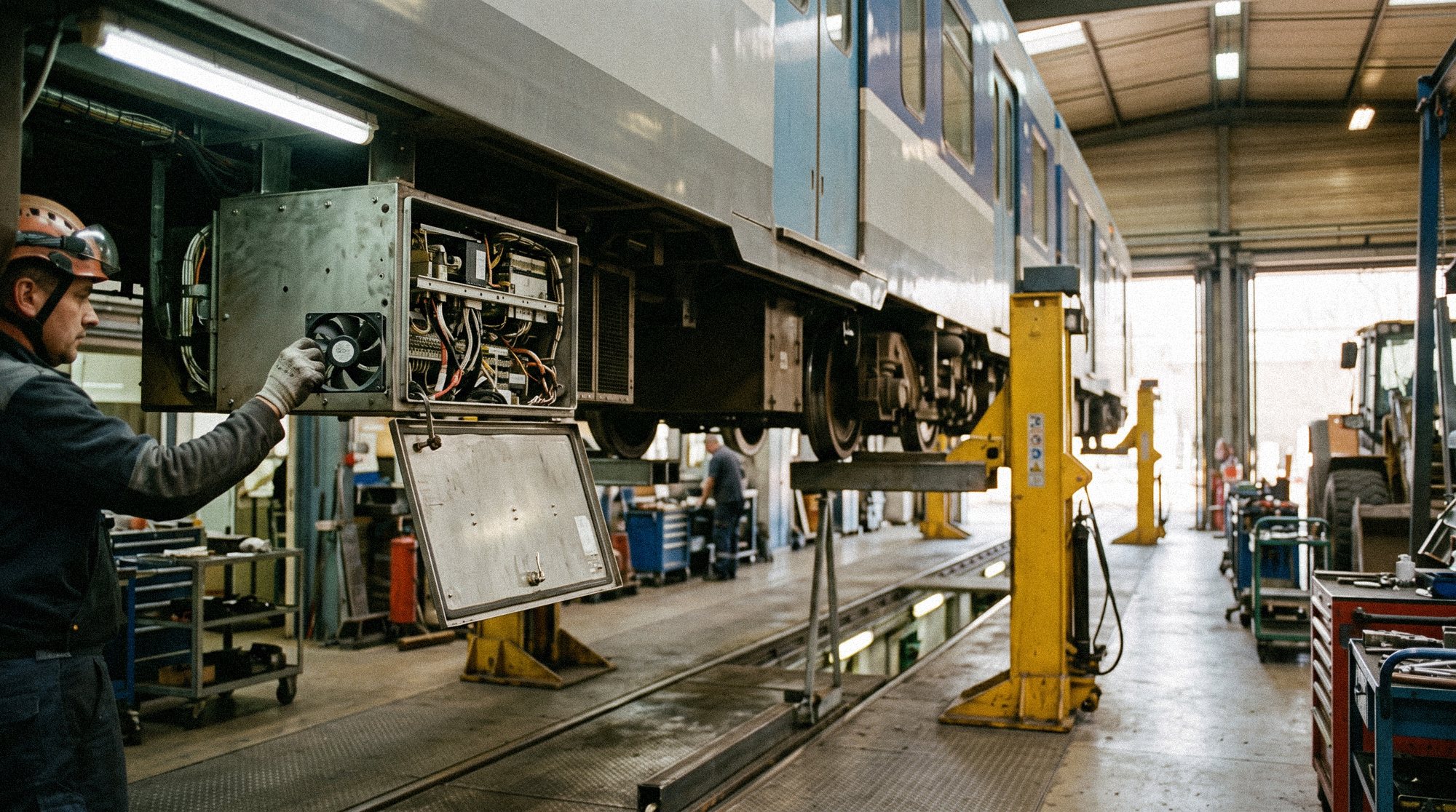
In a fleet of regional multiple units, fans in the underfloor equipment boxes start failing in numbers after a few years of operation. The vehicle manufacturer lists the part in its spare parts list but cannot deliver. The fan manufacturer has discontinued the series. A successor model exists, but has a slightly different design and a different connector.
Maintenance examines three routes: remaining stock of the original part on the market, adaptation of the successor model with technical assessment and approval, and repair of the defective fans. In the end, supply is covered from remaining stock in the short term, and the successor model is approved in the medium term. A process that could have been prepared with a forward-looking obsolescence review.
Common mistakes in practice
- Noticing discontinuations of bought-in parts only when they fail
- Using industrial parts without checking rail-specific requirements
- Requesting evidence only after delivery
- Ordering overhaul material too late and keeping vehicles out of service longer than planned
- Not documenting knowledge about alternatives, so every workshop searches again
Checklist for manufacturers and maintenance depots
- Life cycle status of critical components known for each fleet
- Bought-in components mapped to manufacturer part numbers
- Rail-specific requirements such as fire protection clarified for every spare part
- Material requirements for overhauls planned and bundled early
- Exchange cycles for assemblies that are no longer available
- Evidence and documents requested with every purchase
How KTB supports you
Since 1976, KTB Europe has been sourcing spare parts and components for industrial customers worldwide. For rail vehicle manufacturers and maintenance depots, we can help above all with industrial bought-in components: fans, contactors, sensors, bearings, pneumatics and electronic components from many manufacturers. We search internationally for hard-to-find and discontinued parts and inspect the goods in our central warehouse. Approval for rail use naturally remains with you.
Find out more on our pages on discontinued spare parts and spare parts management.
Conclusion
Rail vehicles need spare parts for decades. The gap between long vehicle service life and short component cycles can be closed, but only with active obsolescence management, transparency about bought-in parts, good documentation and reliable supply channels.
Looking for a component for rail vehicles? Write to us via the contact page.
Frequently asked questions
Why is spare parts supply for rail vehicles so difficult?
Rail vehicles are designed to be used for several decades, but many of their components, such as electronics, controllers or fans, are only produced for a few years. On top of that come approval requirements, fire protection standards and documentation obligations. A technically suitable part is therefore not automatically permitted for use in the vehicle.
What does EN 45545 cover?
The EN 45545 series of standards sets out the fire protection requirements for rail vehicles in Europe. Among other things, it specifies which requirements materials such as cables, plastics, seals and insulating materials must meet depending on where they are used and the vehicle category. Spare parts containing such materials must meet the relevant requirements.
Can rail vehicle spare parts be replaced with industrial parts?
For non-safety-relevant bought-in components, this is possible in principle if the part is technically equivalent and meets rail-specific requirements such as fire protection. For safety-relevant components in the brakes, running gear or train protection, strict approval rules apply. Every change should be assessed and approved by the responsible manufacturer or maintainer.
How do you plan spare parts for a vehicle overhaul?
Overhauls are easy to plan because the material requirement is largely known. Draw up the material list early, check the life cycle status of the components, bundle orders and request the required evidence at the same time. For assemblies that are no longer available, exchange cycles with repaired parts help.
About the author
Mica Duarte
Senior Procurement Specialist at KTB Europe with over 15 years of experience in global MRO sourcing and supply chain management.
LinkedIn