
6 min read
Note: the following story is a typical scenario. It is put together from sequences of events that occur in many plants. The people, company and details are not real.
A food manufacturer, somewhere in Europe. A packaging line that folds, fills and seals cartons. The line runs on three shifts. On Monday, a promotional week starts for a major retail customer. The warehouse stock is planned for the weekend. It is Friday, 4.40 pm.
4.40 pm: the line stops
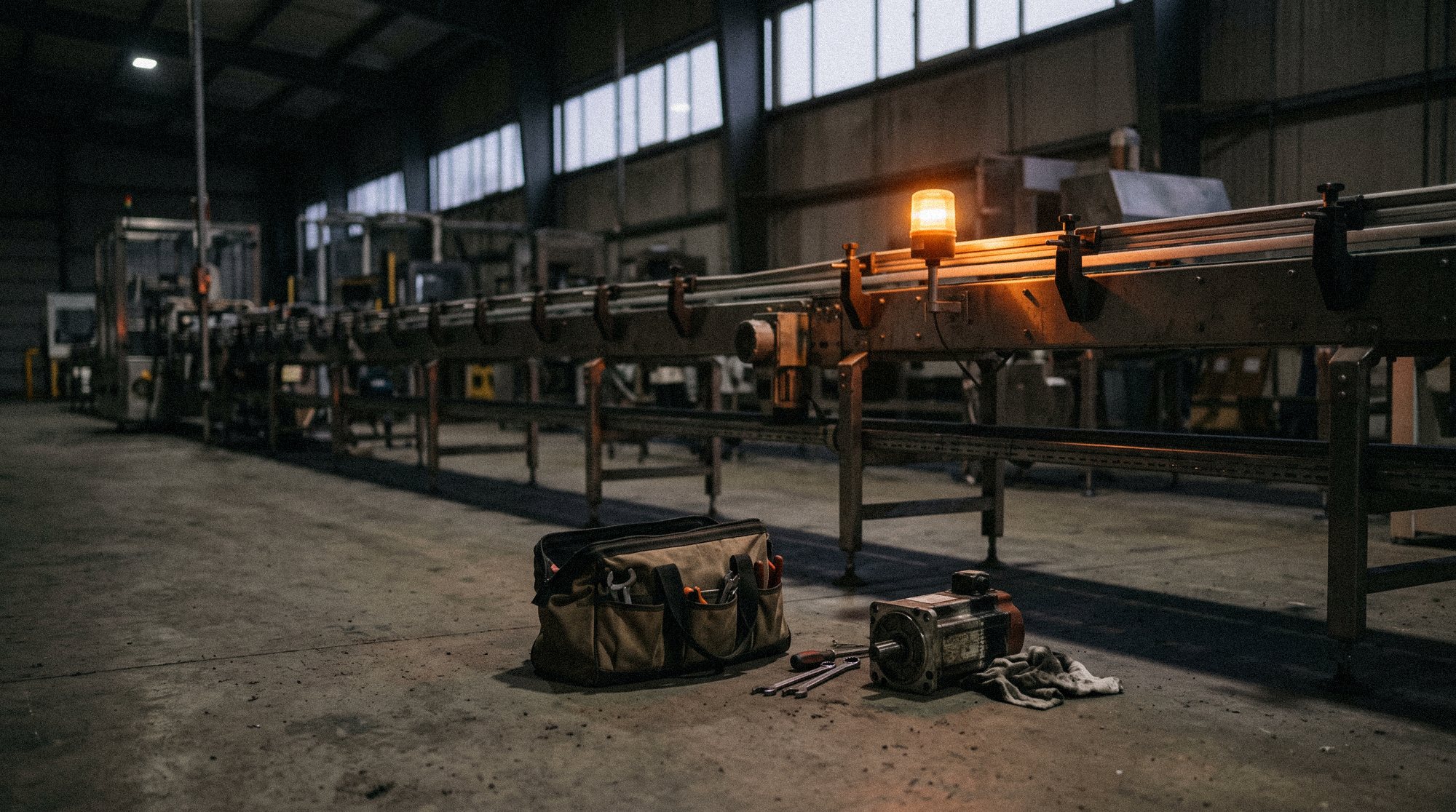
The carton erector comes to a halt. An axis fault message is flashing on the operator panel. The shift supervisor acknowledges it, the machine starts up, then stops again. After the third attempt, he calls maintenance.
The electrician takes measurements, checks connectors and cables, and swaps the cable as a test. The result: the servo motor itself is faulty. The winding has a short. The part has to be replaced.
5.05 pm: a look in the stores
The spare parts store holds a servo motor that looks right at first glance. Same manufacturer, similar designation. On closer inspection, the holding brake is missing and the shaft is a different version. The motor was procured years ago for another machine and never used.
This reveals the first pattern behind many emergencies: the store has parts, just not the right ones. Without well-maintained master data, nobody notices until it is too late.
In an emergency, what counts is not how fast you order. It is how precisely you know what you are ordering.
5.20 pm: the enquiry
The maintenance manager takes over. She knows that in a situation like this, an unclear enquiry costs more time than any delivery route. So before she picks up the phone, she gathers:
- Nameplate: a photo, sharp and complete, including the order number with all suffixes.
- Serial number of the motor and the machine.
- Installation: a photo of the installed motor, the shaft and the connector.
- Technical data: rated torque, speed, brake yes or no, encoder type.
- Drive: type and firmware version of the associated servo drive, in case a motor from another manufacturer is an option.
- Urgency: stated honestly. The line has to be running again early on Monday.
She sends this information to the machine manufacturer and to a multi-brand procurement partner the plant works with regularly. In parallel, not one after the other.
6.00 pm: the options
By early evening, there are three routes on the table:
| Option | Advantage | Catch |
|---|---|---|
| Original motor via the machine manufacturer | guaranteed fit | manufacturer quotes a lead time of several weeks |
| Original motor from a distributor's stock abroad | identical part | origin and condition must be checked |
| Repair of the faulty motor | no new part needed | winding damage, duration unclear |
The decision goes to the distributor's stock, with one clear condition: the motor is checked for type, condition and completeness before dispatch. At the same time, the faulty motor is sent for repair. In future, it will serve as a reserve.
Saturday: goods receipt
The motor arrives. Maintenance compares the nameplate with the photo of the old motor. Order number, shaft version, brake, connector: everything matches. Installation takes a few hours. Then comes commissioning, with parameter setting in the drive.
A detail that is easily forgotten under stress: after a servo motor is replaced, the drive often has to learn the new encoder first. Clarifying this with the manufacturer or the programmer in advance saves an hour of troubleshooting on Saturday.
Monday: the debrief
The line is running. The promotional week starts on time. On Monday afternoon, the team sits down together. Not to find someone to blame, but to answer three questions:
- Why didn't we have the right motor in stock?
- Which other parts on this line could fail in the same way?
- What would have saved us an hour on Friday?
The answers are sobering in their simplicity. The motor had never been rated as critical. The wrong motor in the store had an inaccurate description. And the nameplate photos could have been in the master data long ago.
What a weekend can cost: a sample calculation
The line was back up in time. Even so, it is worth looking at the costs. The following values are fictitious and serve only as an illustration. Insert your own figures.
- Downtime from Friday evening to Saturday midday: around eighteen hours of lost production
- Extra shifts for the electrician and the maintenance manager on Friday evening and Saturday
- Express surcharges for short-notice procurement
- Repair of the faulty motor
- Time spent on the debrief on Monday
Add these items up and they usually exceed the price of a reserve motor many times over. That is not a statement about your plant. But it is a calculation every plant should do once for its own critical parts. It is the strongest argument in any discussion about spare parts stock.
And if the line had not been running by Monday?
That is part of an honest assessment too. Not every emergency ends well. Sometimes the part is simply not available anywhere at short notice. Then only plan B and plan C will help: a rush repair, a part taken from an identical installation at another plant, a temporary modification or a transfer of production. If you have already thought these options through for your most important equipment, you will decide faster and more calmly when it counts.
What this scenario teaches about spare parts procurement
1. Data beats speed
If you have the nameplate, technical data and installation details to hand, every enquiry gets shorter. Store photos and data sheets for critical parts in your master data while the equipment is still running.
2. In parallel, not one after the other
In an emergency, try several routes at the same time. Manufacturers, distributors and repairers each need their own time. If you ask one after the other, you add those times up.
3. Know your alternatives in advance
Whether a third-party motor or a successor type will fit is better clarified calmly than on a Friday evening. For critical drives, it pays to check and document compatible alternatives technically in advance.
4. Check before installation
Especially with parts from distributor stock: check type, condition and completeness before the fitter turns up. The wrong part on Saturday morning is worse than the right part on Saturday at midday.
5. Turn the damage into a reserve
Many faulty parts can be repaired. A repaired motor on the shelf is worth its weight in gold the next time something fails.
The emergency checklist for your maintenance team
Put this list up wherever the phone calls are made when it counts:
- Photo of the nameplate, complete and legible
- Manufacturer and full order number
- Serial number of the part and the machine
- Photo of the installation and the connections
- Key technical data of the part
- Quantity required and delivery location
- Realistic target date
- Are alternatives technically permitted? Who approves them?
- Who can be reached at the weekend?
Where a procurement partner helps
Since 1976, KTB Europe has been procuring spare parts for industrial customers worldwide, across manufacturers and internationally. In an emergency, this means: we search across different suppliers and countries for the part or a technically suitable alternative, and come back to you with concrete options, prices and lead times. We check procured goods for quality and quantity in our central warehouse.
You can find out how an enquiry works on our page on spare parts procurement. To make next Friday a calmer one, it is also worth taking a look at our spare parts management.
Conclusion
Emergencies cannot be abolished. But they can be shortened. Most of the time is not lost on the road or in the air, but in unclear enquiries, wrong parts in the store and decisions that are only made under stress.
Missing a part right now? Send us a photo of the nameplate and the part number via our contact page.
Frequently asked questions
What information do I need for fast spare parts procurement?
The most important items are the manufacturer and the full order number, a sharp photo of the nameplate, the serial numbers of the part and the machine, and a photo of the installation. Key technical data, the quantity required, the delivery location and a realistic target date also help. The more complete the enquiry, the fewer follow-up questions there will be.
Should I contact several suppliers at the same time in an emergency?
Yes. Manufacturers, distributors and repairers each need their own time to check and quote. If you ask one after the other, you add those times up. Parallel enquiries shorten the path to a decision considerably. It is important to give everyone the same complete information so that the quotes are comparable.
Can I use a spare part from a different manufacturer?
Often, yes, if the part is compatible in form, function and connections. For drives and control components, this also includes encoder type, communication and software. The approval should be technically justified and documented. Ideally, clarify alternatives for critical parts in advance, not in the middle of an emergency.
How do I prevent an emergency like this from happening again?
Assess the criticality of your spare parts together with maintenance, store photos, data sheets and full part numbers for critical parts in your master data, and check whether the parts in stock really match the parts installed. Have faulty parts repaired and keep them as a reserve.
About the author
Mica Duarte
Senior Procurement Specialist at KTB Europe with over 15 years of experience in global MRO sourcing and supply chain management.
LinkedIn