
6 min read
European machines have a good reputation in American plants. Packaging machines from Italy, machine tools from Germany, conveyor technology from the Netherlands, process technology from Scandinavia. Many US plants have been running such equipment reliably for years.
Until a spare part is needed. Then it becomes clear that the machine contains two technical worlds: the European base design and the American adaptations. And the local distributor often carries only one of them.
What a European machine changes in the US
For a machine to be operated in the US, it is usually adapted. These adaptations later determine which spare parts fit.
60 Hz instead of 50 Hz
The US power grid runs at 60 Hz, the European one at 50 Hz. At 60 Hz an induction motor turns roughly a fifth faster. Pumps, fans and drives are therefore often installed in a different version, or the speed is adjusted with a frequency inverter. If you order a replacement motor by the European standard number, you may get the wrong winding.
Different voltages
Industrial equipment in the US often runs on 480 V three-phase, sometimes on 208 V or 230 V. In Europe 400 V is common. Transformers, motors, power supplies and contactors have to match. Control voltages can also differ.
UL, NFPA and CSA
In the US, electrical components and control cabinets usually have to meet certain standards. Frequently cited are UL 508A for industrial control panels and NFPA 79 for the electrical equipment of machines. In Canada, CSA plays a similar role. A spare part without a suitable listing can become a problem during an inspection, even if it works technically.
Inches and millimetres
The base design of a European machine is metric. Screws, shafts, bearings and profiles follow metric standards. If parts were added in the US, such as safety fencing, connecting pipes or fixings, these are often imperial. Maintenance needs both sets of tools and both spare parts ranges.
IEC and NEMA
European motors follow IEC standards for frame sizes and mounting, American motors follow NEMA standards. The dimensions are not compatible. A NEMA motor does not simply fit an IEC flange. If you want to use a locally available motor in an emergency, you need adapters or modifications.
A European machine in America contains two worlds of standards. Your spare parts management has to speak both.
Why the local distributor often cannot help
The US has a dense network of industrial distributors. For American makes and common international brands, availability is excellent. With specialist European manufacturers it is a different story. Many have only a small sales company or a representative in the US. Some have none at all. Spare parts then come from Europe, often through several stages.
On top of that, American distributors like to offer an American equivalent for European parts. That can work. But it can also fail on dimensions, connections or standards if nobody checks equivalence properly.
Reading the documentation correctly
European manufacturers often supply US customers with documentation based on the European standard version and only partly adapted to the US version. Spare parts lists then contain the European numbers, while the machine contains the US variants. So for every critical component, check whether the number in the documentation matches the one on the nameplate. Discrepancies belong in the master data immediately, not at the next breakdown.
Five rules for spare parts supply
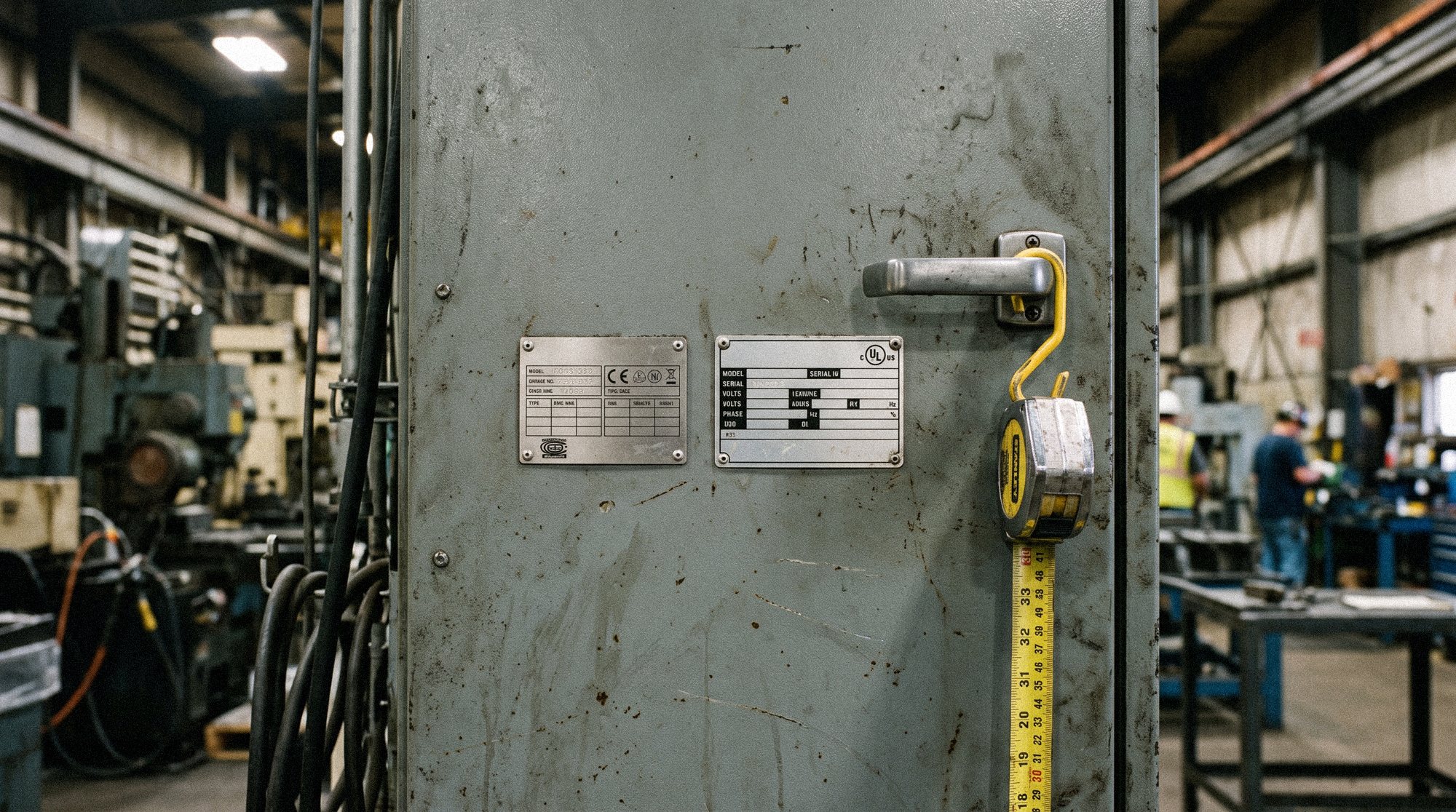
- Document the version actually installed. Photograph nameplates rather than simply adopting the bill of materials from Europe. The US version often has a different part number.
- Clearly separate metric and imperial parts. In the master data, in the store and when ordering.
- Approve alternatives technically. If an American equivalent is to be used, equivalence should be checked and documented, including standards and listings.
- Stock critical European parts. Parts that only come from Europe and can stop a line belong in the plant store.
- Establish a sourcing channel to Europe. Rather than looking for a new route for every part, have a reliable partner who knows the European manufacturers and sources the parts in the right version.
Older equipment: double the risk
Many European machines in US plants have been running for twenty years or more. This adds a second problem to the question of standards: product discontinuations. The US version of a component was often made in smaller quantities than the European one and is therefore discontinued sooner. At the same time the European successor version is not listed for the US market. If you operate older European equipment, you should regularly check the lifecycle status of critical components and decide on stockholding or modernisation in good time.
Thinking about Canada and Mexico too
Many companies operate plants in several North American countries. Like the US, Canada uses 60 Hz but has its own requirements for electrical components. Mexico also uses 60 Hz and has its own standards. If identical European machines are installed in all three countries, a joint spare parts concept with clear rules on which version is permitted where pays off. It saves duplicate stock and prevents a part from one plant not being allowed in another.
Trade policy: a factor that changes
Import duties and trade rules between the US and other countries have changed several times in recent years and may continue to change. For spare parts from Europe this means: the cost of an import is not always the same. Keep an eye on developments and, for larger orders, clarify the current situation with your customs department or customs broker. For strategic planning it can make sense to stock critical parts during calmer periods.
What belongs in the master data
For European equipment in US plants, spare parts master data should contain more than usual: the European and the US part number, voltage and frequency, the relevant listing and a note on whether the part is metric or imperial. Plus a photo of the nameplate. This takes a few minutes when creating the record and saves hours at the next breakdown.
Typical scenario: the fan motor
A food plant in the US operates a cooling tunnel from a European manufacturer. A fan motor fails. Maintenance finds a part number in the European documentation and orders an American equivalent with the same output from the local distributor. The part arrives quickly. During installation it turns out that the flange does not fit and the shaft has a different diameter. A second attempt with a European 50 Hz version fails because of the wrong speed.
In the end it turns out that the manufacturer had installed its own 60 Hz variant with its own part number for the US market. It was on the nameplate, but not in the documentation. The lesson: the nameplate beats the parts list.
KTB in the US
KTB is represented in the American market by its own company, KTB-USA Import-Export, LLC in Miami. With our head office in Hamburg and our presence in the US, we combine access to European manufacturers with the American market. This allows us to source spare parts for European equipment in US plants in the right version and, if needed, to find technically verified alternatives.
Find out more about our approach on the procurement and discontinued spare parts, as older European equipment in the US is particularly often affected by discontinuations.
Conclusion
European machines in American plants are a good combination. To keep it that way, spare parts supply has to cover both worlds: the metric European base design and the American adaptations. If you document nameplates, check alternatives properly and have a reliable channel to Europe, you avoid the typical pitfalls.
Do you operate European equipment in the US? Get in touch via our contact page .
Frequently asked questions
Why do European spare parts not always fit US machines?
European machines are usually adapted for the US market: to 60 Hz instead of 50 Hz, to other voltages such as 480 V and to standards such as UL and NFPA. As a result, many components have a different version and part number than in Europe. If you order by the European standard number, you may receive a variant that does not fit.
Can I replace a European motor with an American one?
In principle yes, but not without checking. European motors follow IEC standards, American motors NEMA standards. Frame sizes, flanges and shaft diameters are not compatible. Output, speed, voltage, frequency and degree of protection must also match. Adapters or modifications are often needed. Equivalence should be checked technically and documented.
Which standards matter for spare parts in US plants?
Frequently relevant are UL 508A for industrial control panels and NFPA 79 for the electrical equipment of machines. In Canada, CSA approvals play a similar role. A spare part without a suitable listing can become a problem during inspections. The requirements that apply in each case are best clarified with your qualified electrician or your safety officer.
How do I organise spare parts for European equipment in the US?
Document the versions actually installed using the nameplates, separate metric and imperial parts in the master data, check American alternatives technically and stock critical parts that only come from Europe. A partner with a presence in Europe and the US can compare sourcing channels and procure the right version.
About the author
Mica Duarte
Senior Procurement Specialist at KTB Europe with over 15 years of experience in global MRO sourcing and supply chain management.
LinkedIn