
6 min read
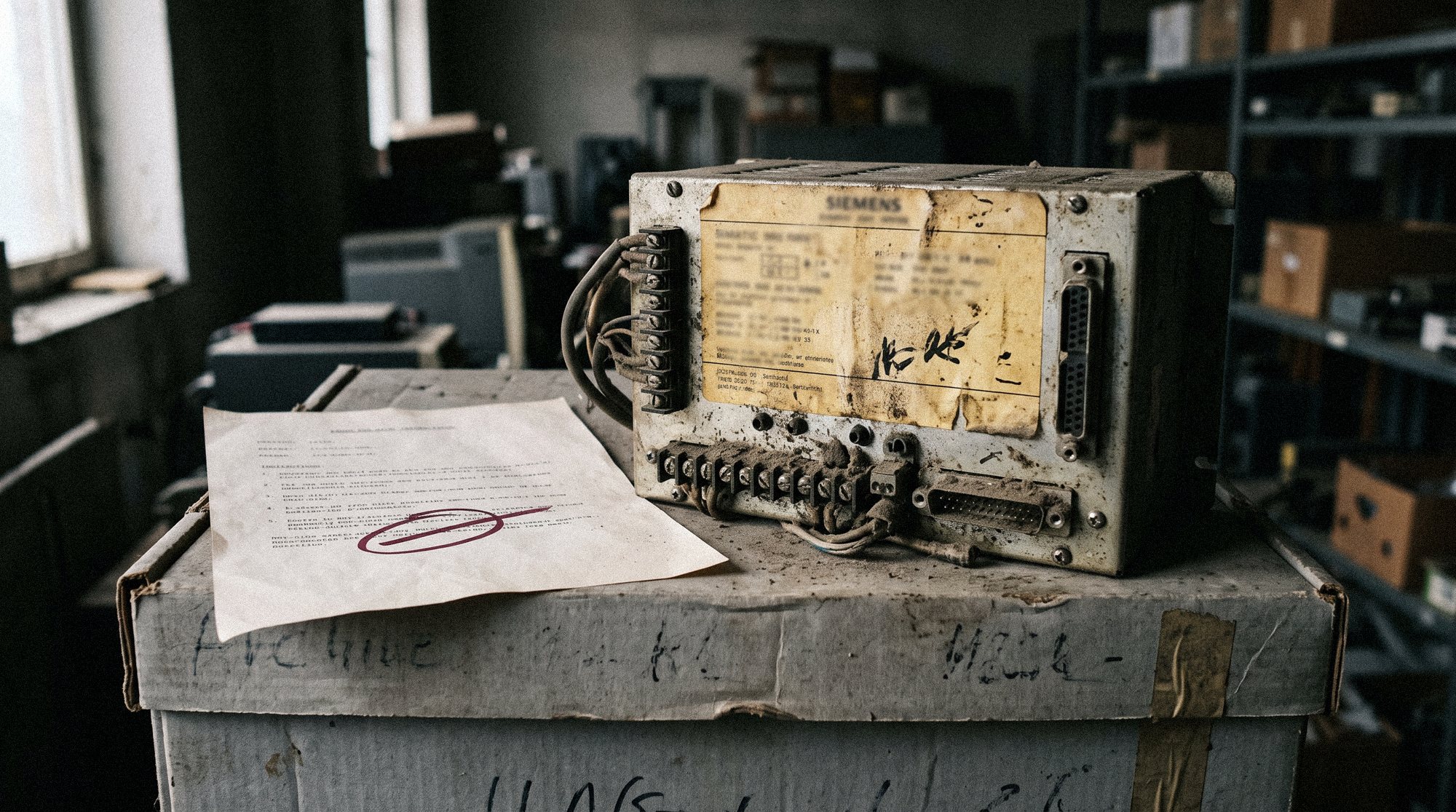
Typical scenario: A filling line has been running for fifteen years without major problems. Then an I/O module in the control system fails. Maintenance orders a replacement and receives a short reply: item discontinued, successor not compatible. A routine repair turns into a project.
This pattern repeats itself in many plants. Machines last longer than their components stay in the manufacturers' ranges. Obsolescence management makes sure this does not take you by surprise.
What is obsolescence?
Obsolescence means that a component is no longer manufactured or no longer sold. You will also hear the terms ‘obsolete parts’ or ‘end of life’. The reasons vary:
- The manufacturer switches to a new product generation.
- A sub-supplier drops out, for example for a chip or a special material.
- Standards or environmental regulations ban certain substances.
- The manufacturer is taken over and the range is streamlined.
- Demand has simply become too low.
Electronics and automation technology are particularly affected. Their life cycles are often much shorter than those of the mechanical systems they are built into. A gearbox runs for decades. The control system next to it is technically outdated after a few years.
The phases leading up to discontinuation
Discontinuations rarely happen overnight. Most manufacturers communicate in stages, even if the terms vary:
| Phase | What it means | What you should do |
|---|---|---|
| Active | Part is in normal production | Record stock and installation locations |
| Phase-out announced | End of production has been scheduled | Estimate demand until the end of the plant's life |
| Last order | Last time buy deadline is running | Decide: stock up or convert |
| Repair only | No new parts, possibly repair | Clarify repair routes and alternatives |
| Discontinued | No more support | Search the market for remaining stock, redesign |
The problem: these notices often land in the inbox of a buyer who does not know the plant, or on a manufacturer's website that nobody reads regularly.
Obsolescence is not an event but a process. If you watch it, you have time. If you miss it, you have downtime.
Obsolescence management in five steps
1. Inventory of critical components
Do not start with all parts. Start with those whose failure stops a plant and that have no simple replacement. Typical examples are control modules, drives, operator panels, special sensors and machine-specific mechanical parts.
2. Check the status regularly
For every critical part, you should know which life cycle phase it is in. Many manufacturers offer status queries or newsletters for this. What matters is that one person is clearly responsible and the check is repeated at fixed intervals.
3. Assess the risk
Combine two questions: how likely is a discontinuation? How serious would a failure be? A discontinued sensor with three compatible alternatives is a small risk. A discontinued safety controller in a bottleneck plant is a big one.
4. Define a strategy
There are several answers to every risk:
- Last time buy: Buy and store the remaining demand until the planned end of the plant's life.
- Alternative: Approve a part from another manufacturer that is compatible in form, fit and function.
- Repair: Have defective assemblies repaired, provided this makes technical and economic sense.
- Remaining stock: Source new goods or unused surplus stock from the market.
- Redesign or retrofit: Modernise the affected assembly before the pressure becomes too great.
What belongs in an obsolescence list
A simple table is enough to start with. What matters is that it is kept up to date. These columns have proven their worth:
| Column | Content |
|---|---|
| Part | Manufacturer, full part number, description |
| Use | Plant, assembly, number of parts installed |
| Status | Life cycle phase according to the manufacturer, date of last check |
| Stock | Parts in your own warehouse, storage location |
| Risk | Consequence of a failure, known alternatives |
| Action | Chosen strategy, person responsible, deadline |
5. Document and repeat
Record which decision was made and why. Whoever faces the same part in three years' time will be spared the same research.
Last time buy: getting the numbers right
A last time buy looks simple. You buy enough to last until the end of the plant's life. In practice, the calculation is tricky. Buy too little and the problem comes back later. Buy too much and capital sits on the shelf for years.
A simple example calculation: a plant is expected to run for another eight years. Six units of a module are installed. In the past, about one failed every two years. Purely mathematically, that would be four parts. Add a safety margin, because failure rates often rise with age. In the end, perhaps five or six parts sit in the warehouse. This calculation is only an example. But it shows that a last time buy is a technical decision, not just a purchasing one.
Also pay attention to shelf life. Electronics with capacitors, rubber parts and seals age on the shelf too. Clarify storage conditions before you put larger quantities into stock.
Warning signs you should take seriously
Not every discontinuation comes with an official letter. Often it announces itself more quietly. Watch out for these signs:
- The lead time for a previously common part suddenly increases significantly.
- When you enquire, the manufacturer names a ‘successor type’, even though you ordered the original.
- The price jumps for no apparent reason.
- Distributors can only offer the part from remaining stock.
- The technical documentation disappears from the manufacturer's website.
- The manufacturer has been taken over or has reorganised its portfolio.
None of these signs is proof on its own. Together, they are a good reason to actively ask the manufacturer about the status.
Factoring obsolescence into retrofits
Many plants modernise their equipment step by step. This creates a risk that is often overlooked: the new control system is installed, but drives, sensors and operating elements remain old. Obsolescence simply moves somewhere else.
With every retrofit, check which components will be phased out in the coming years. Sometimes it is cheaper to replace an assembly at the same time rather than tackle it in a second project a few years later. Conversely, it can make sense to keep removed components that still work as spare parts for identical plants.
When it is already too late
Sometimes the part has already been discontinued before anyone notices. Then the search begins. Three routes have proven effective:
- Exact identification: manufacturer, full part number including version or revision status, photos of the nameplate and the installation situation. Without this data, every search becomes guesswork.
- International remaining stock: What is sold out in Europe is sometimes still held by a distributor in America or Asia. This is where a network spanning several continents pays off.
- Technically verified alternatives: A successor or a third-party product can fit if dimensions, connections, performance data and software are compatible. This check requires care, not haste.
With remaining stock from the market, inspecting the goods is especially important. Condition, packaging, marking and origin should be checked before installation. KTB inspects sourced parts in its own central warehouse in Hamburg before they are passed on. More on this on our page on inspection.
Who takes care of it?
Obsolescence management rarely fails for lack of knowledge. It fails for lack of ownership. Maintenance knows the plants, procurement knows the suppliers, engineering knows the alternatives. A clearly designated person for each plant or group of plants, who brings the threads together, has proven effective.
External partners can help, for example with the worldwide search for remaining stock or with clarifying alternatives across manufacturers. KTB has been sourcing spare parts for industrial customers worldwide since 1976, including parts the manufacturer no longer supplies. You can find out how we go about it on our page on discontinued spare parts.
Conclusion
Discontinuations cannot be prevented. But they can be managed. If you know your critical parts, track their status and have a strategy for every risk, you decide for yourself when to act.
Facing a discontinued part? Send us the manufacturer, part number and a photo of the nameplate via our contact page. We will check which routes are still open.
Frequently asked questions
What is obsolescence management?
Obsolescence management is the systematic control of components that the manufacturer is discontinuing or that will soon no longer be available. It involves recording critical parts, regularly checking their life cycle status, assessing the risk of failure and choosing a strategy such as a last time buy, an alternative, repair or modernisation.
What does ‘discontinued’ mean for spare parts?
Discontinued means that the manufacturer no longer produces a part or will stop doing so in the foreseeable future. There is often an advance notice with a final ordering deadline. After that, the part is only available from remaining stock, through repair or as a technically compatible alternative. Manufacturer support may end as well.
What is a last time buy?
A last time buy is the final order of a part before production ends. You buy the estimated remaining demand up to the planned end of your plant's life. The quantity depends on the number of parts installed, the failure rate so far, the remaining service life and the shelf life. The decision should be made together with maintenance.
What should you do if a spare part is no longer available?
Identify the part as precisely as possible: manufacturer, full part number, version status, photos of the nameplate. Then check three routes in parallel: remaining stock on the international market, repair of the defective assembly and technically compatible alternatives. Have third-party goods inspected for condition and authenticity before installation.
Which parts are particularly affected by obsolescence?
Electronics and automation technology are affected most often, such as control modules, operator panels, frequency inverters, servo drives and special sensors. Their product cycles are much shorter than those of the mechanical plants they sit in. But special mechanical parts from smaller manufacturers can also suddenly disappear after takeovers or range rationalisations.
About the author
Mica Duarte
Senior Procurement Specialist at KTB Europe with over 15 years of experience in global MRO sourcing and supply chain management.
LinkedIn