
6 min read
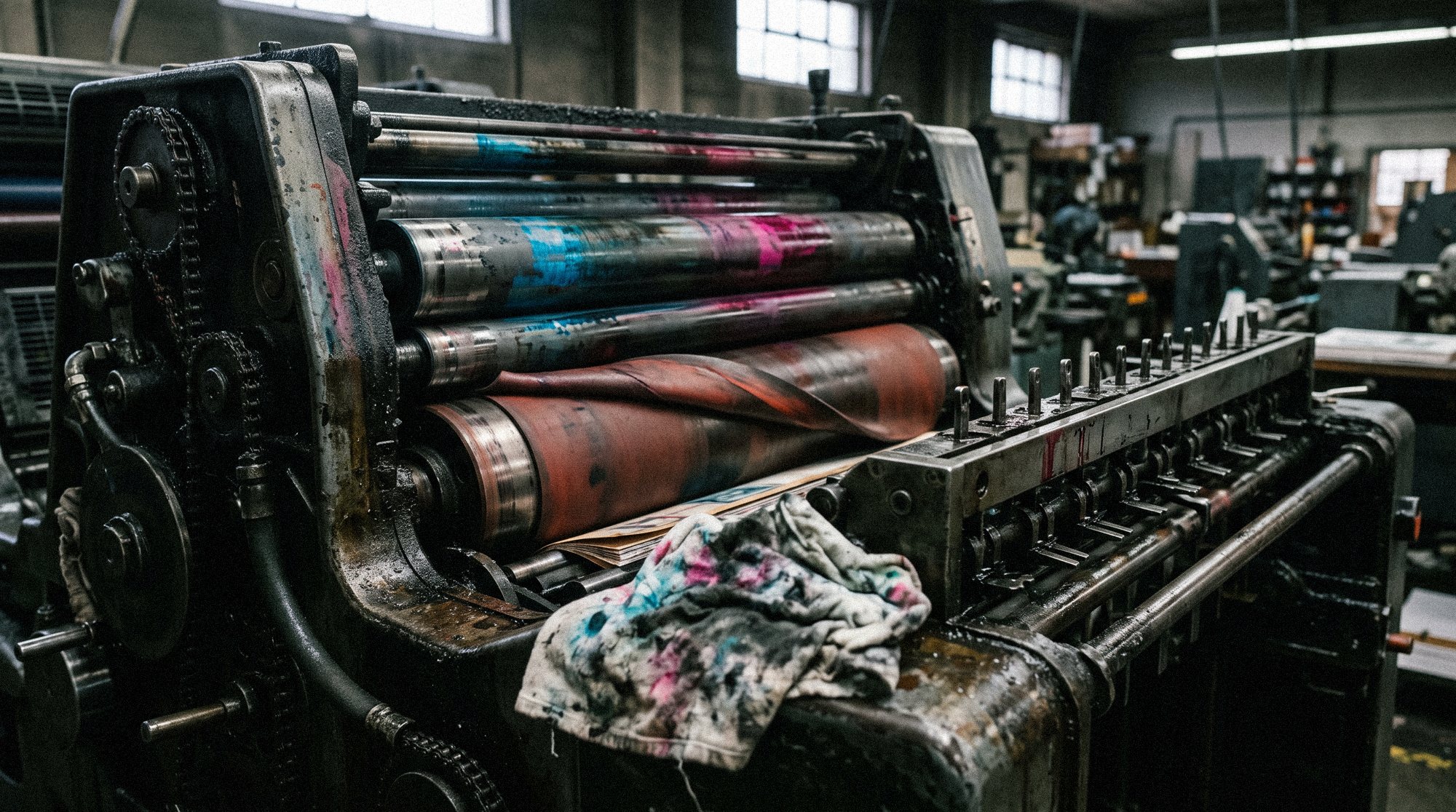
Many print shops run machines that are older than some of their printers. Sheetfed offset presses, web offset lines, flexo and gravure presses are solidly built. With good maintenance they print for decades. That is a stroke of luck for the print shop and a challenge for spare parts supply.
Because while the press keeps running, the market around it has changed. This article shows what that means and which strategies help.
A market in transition
The printing industry has gone through profound change over recent decades. Demand has fallen in newspaper and commercial printing, while it has grown in packaging printing. Press manufacturers have merged, repositioned themselves or discontinued product lines. For operators of older presses, this has consequences:
- Spare parts programmes for older series are being thinned out.
- Electronic assemblies are discontinued because their components are no longer available.
- Service networks concentrate on current machines.
- Many used presses are exported and keep running in other countries, where the spare parts question is even harder.
A printing press rarely dies of wear. It dies of a spare part that no longer exists.
Which parts cause problems
Electronics and controls
The biggest weak point of older printing presses is the electronics. Control boards, press consoles, drive controllers and sensors with manufacturer-specific interfaces are often no longer available after a few years. Because they are machine-specific, there is no simple alternative from the catalogue.
Special mechanical parts
Grippers, gripper shafts, cams, gears, cylinder bearings: many mechanical parts are made specifically for one series. For older presses they are often only available from the manufacturer, and sometimes not at all.
Bought-in components
A large share of a printing press consists of components from other manufacturers: motors, pumps, pneumatics, bearings, sensors, couplings, brakes. These parts are often available independently of the press manufacturer, provided you can identify them. This is where a large, often untapped potential lies.
Consumables and wear parts
Blankets, roller coverings, doctor blades, suckers, belts and filters are replaced regularly. For these there is usually a functioning market with several suppliers.
Five strategies for older printing presses
1. Identify bought-in parts
Go through the press systematically and identify all components that come from third-party manufacturers. Motors, valves, bearings and sensors often carry the nameplate of the actual manufacturer. With this data, you no longer depend solely on the press manufacturer. That lowers costs and opens up additional supply channels.
2. Secure the electronics
Draw up a list of critical electronic assemblies and check their status with the manufacturer. For discontinued assemblies there are three routes: buy spare assemblies while you still can, have defective assemblies repaired by specialised electronics workshops, or plan a modernisation of the controls.
3. Use donor machines
When identical presses are decommissioned, they can serve as spare parts donors. Some print shops deliberately buy a second, older press of the same series to harvest parts. This takes effort, but can be the only way to keep a press running. It is important to inspect removed parts before installing them.
4. Consider reproduction
Special mechanical parts can often be reproduced if drawings or a sample part are available. For simple parts this is economical. For complex parts such as cams or grippers, you need specialised manufacturers and precise inspection.
5. Search for remaining stock internationally
What is no longer available in one country is sometimes still on the shelf in another. Distributors, print shops decommissioning presses or stock held by former agencies can be sources. An international search needs contacts, languages and the ability to inspect parts from unknown sources.
The role of documentation
Many print shops hold extensive spare parts catalogues for their older presses, often still on paper. These catalogues are valuable because they contain drawings, item numbers and original part numbers. Digitise them while they are still legible and add the manufacturer data of the bought-in parts. This creates a knowledge base that still helps when the manufacturer no longer offers support.
Packaging printing: high utilisation, little buffer
In the growing packaging printing sector, flexo and gravure presses often run multiple shifts, tied into the tightly scheduled supply chains of brand owners. A press failure delays not just one job but possibly the delivery of a product to retail. The pressure on maintenance is correspondingly high. A clearly defined stock of critical spare parts and pre-approved alternatives for bought-in components pay off particularly well here.
Used printing presses abroad
Many printing presses begin their second life in another country. Used presses from Europe keep running in Latin America, Eastern Europe, Africa or Asia. For the new operators, the spare parts question is even harder than for the original owner. The manufacturer often has no local branch, the documentation is in a foreign language, and the bought-in parts are unknown locally. It pays to take as many documents, spare parts and nameplate photos as possible when buying, and to build a supply channel to Europe.
Keep running or modernise?
At some point the question arises whether to keep supplying an older press or to replace it. A simple comparison helps with the decision:
| In favour of continued operation | In favour of modernisation |
|---|---|
| Mechanics in good condition | frequent electronics failures |
| Bought-in parts well identified and available | critical assemblies can no longer be repaired |
| Repair of electronics possible | no remaining stock left on the market |
| Press suits the order book | higher demands on quality or speed |
Often the middle way is best: keep the mechanics running and modernise the controls in a targeted way. That extends service life and removes the biggest spare parts weak point.
Maintenance protects spare parts
One point that often gets lost in the discussion: good maintenance reduces spare parts demand. Clean lubrication, regularly changed filters and wear parts replaced in good time prevent consequential damage to expensive, hard-to-source components. Save on consumables and you pay later on the special parts.
Typical scenario: the press console
A print shop runs a sheetfed offset press that operates reliably. One morning the press console fails to start. A board in the computer is defective. The manufacturer says the assembly is no longer supplied and recommends modernising the console. That would take several weeks.
The print shop looks for alternatives in parallel. A specialised electronics workshop can repair the board. In addition, a used assembly turns up at a distributor abroad. The press is back in operation after a short time. The modernisation is still planned, but at a time the print shop chooses itself.
Who helps with the search
With hard-to-source printing press parts, a single route rarely succeeds. The manufacturer knows the design, electronics workshops can repair, distributors hold remaining stock, and multi-brand procurement partners know the bought-in components and international sources. If you know these routes and use them in parallel, you find a solution faster than someone who asks one after the other.
Checklist for print shops
- Bought-in components documented with nameplates
- Critical electronic assemblies and their status known
- Contacts with electronics workshops for repairs
- Spares for critical, discontinued assemblies
- Drawings or samples for special mechanical parts secured
- Consumables covered by framework agreements
- Modernisation plan for the controls before a failure dictates the timing
How KTB supports you
Since 1976, KTB Europe has been sourcing spare parts for industrial customers worldwide, across manufacturers and internationally. For print shops and packaging printers we identify and source bought-in components, search internationally for discontinued parts and remaining stock, and inspect the goods in our central warehouse in Hamburg before they are shipped to you.
Find out more on our pages on discontinued spare parts and procurement.
Conclusion
Older printing presses are often economical and reliable. To keep them that way, you need an active spare parts strategy: identify bought-in parts, secure the electronics, tap alternative sources and plan modernisations in good time. Work this way and you decide when a press retires, not a missing part.
Looking for a spare part for your printing press? Send us the nameplate and part number via the contact page.
Frequently asked questions
Why are spare parts for older printing presses hard to get?
The printing industry has changed dramatically. Manufacturers have merged, discontinued series and thinned out spare parts programmes. Electronic assemblies and special mechanical parts made specifically for one series are particularly affected. Yet the presses themselves often keep running for decades, creating a gap between service life and spare parts supply.
Can you source printing press spare parts without the manufacturer?
For bought-in components such as motors, pumps, pneumatics, bearings and sensors, often yes. These parts usually carry the nameplate of their actual manufacturer and are available independently of the press manufacturer. For machine-specific parts such as grippers or control boards, the routes remain the manufacturer, remaining stock, repair or reproduction.
What can you do when an electronic assembly is discontinued?
Pursue three routes in parallel: buy spare assemblies from remaining stock, have defective assemblies repaired by specialised electronics workshops and plan a modernisation of the controls in the medium term. The key is to know your critical assemblies before they fail, so you do not have to decide under time pressure later.
Is a donor machine for spare parts worth it?
If a series is barely supported any more and your own press keeps running economically, a decommissioned identical press can be a valuable source of parts. However, the effort for dismantling, storing and inspecting the parts is considerable. Check beforehand which critical parts the donor machine actually provides and what condition they are in.
About the author
Mica Duarte
Senior Procurement Specialist at KTB Europe with over 15 years of experience in global MRO sourcing and supply chain management.
LinkedIn