
6 min read
In the engine room of a merchant vessel, the main engine, auxiliary diesels, pumps, separators, compressors, coolers, boilers and many other units are at work. Many of them come from different manufacturers all over the world. If one fails, the crew faces a challenge that is rare ashore: the spare part has to be right first time. Because weeks can pass before the next opportunity to get it on board.
This article focuses on the first step of any spare parts procurement for ships: correct identification. We deliberately leave out delivery to the vessel. That is a topic in its own right for ship agents and logistics providers.
Why ship spare parts are different
Many manufacturers, old designs
A ship is in service for decades. Its machinery dates from the time of construction and is partly replaced over the years. Some manufacturers no longer exist or have been taken over. The documentation on board is sometimes complete, sometimes patchy.
Licence-built machinery
Many marine engines and units are built under licence. An engine from a well-known designer may have been manufactured by a licensee in another country. Spare parts can differ depending on the licensee.
Class and regulations
Ships are subject to the rules of their classification society and to international regulations. For certain components, class requires evidence or approvals. A spare part that fits technically but lacks the required evidence can become a problem during a survey.
No second chance
Ashore, a wrongly delivered part is annoying. On board, it can mean that a unit is unavailable until the next port. The cost of a wrong order is correspondingly high.
On board, what counts is not how fast a part is ordered. It is whether it fits when you unpack it.
The five details that matter
In practice, five details have proven their worth for identifying a ship spare part. The more complete they are, the lower the risk of a wrong order.
1. Manufacturer of the unit
Not the shipbuilder, but the manufacturer of the engine, pump or separator. For licence-built machinery, the licensee as well.
2. Type and model
The exact type designation of the unit, as shown on the nameplate. Small differences in the designation can mean big differences in the parts.
3. Serial number
The serial number of the unit allows the manufacturer to determine the exact version. With engines in particular it is often decisive, because parts have changed over the years of production.
4. Drawing and item number
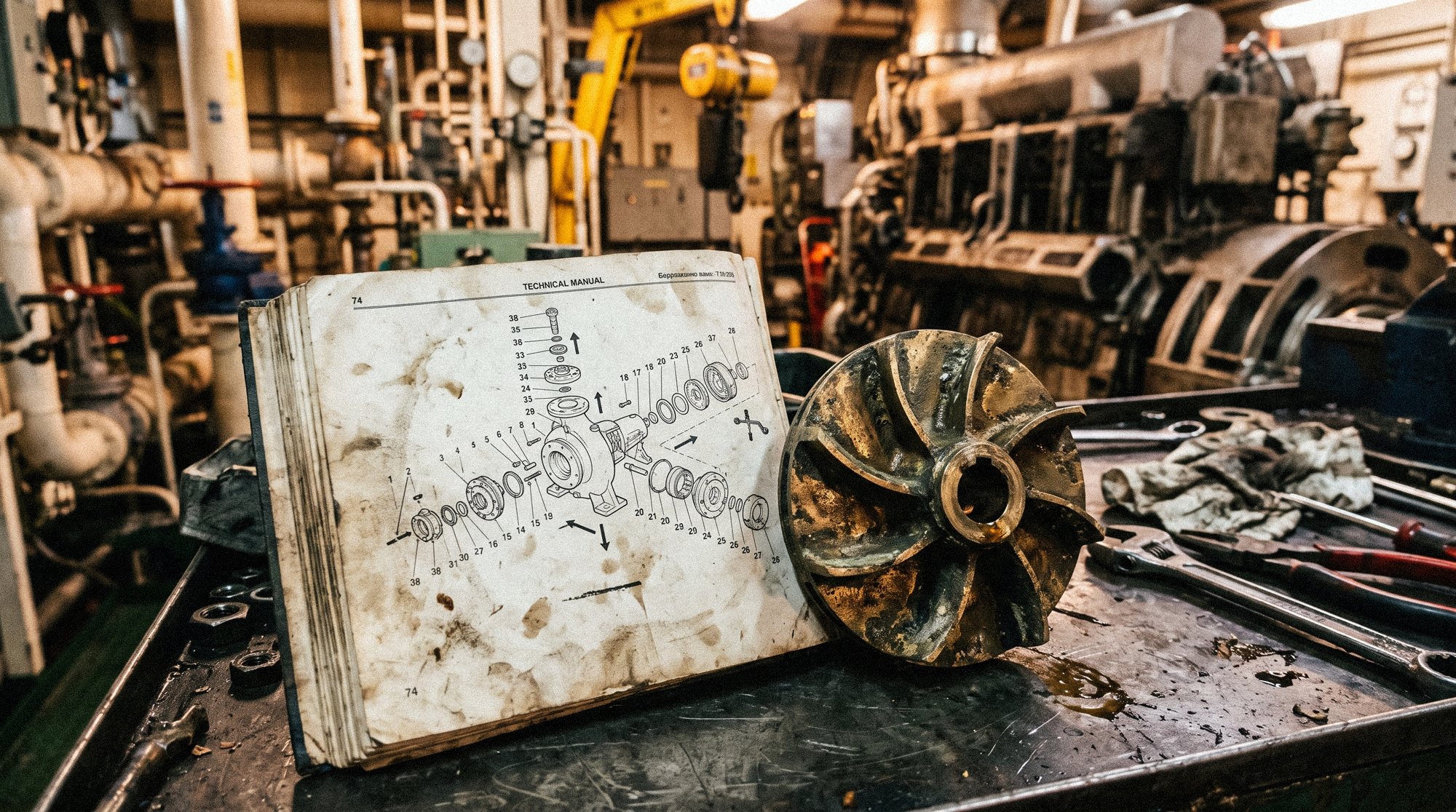
Most manufacturer manuals contain spare parts catalogues with exploded views. Each drawing has a number, and each part in it has an item number. For manufacturers and suppliers, this combination is often the fastest route to the correct part number.
5. Part number and description
The part number from the catalogue, supplemented by the description. Note: manufacturers may have changed part numbers over the years. That is why the combination with drawing and item number is so important.
Other useful details
- Name and IMO number of the vessel, so the supplier can assign the enquiry unambiguously
- Photos of the nameplate and the defective part
- Dimensions, material and operating data for parts without legible markings
- Requirements for evidence, such as mill certificates or class certificates
- Required delivery date and handover location, so planning and documents can be coordinated
Original, equivalent or repaired?
There are several options for ship spare parts:
| Option | Advantage | Points to note |
|---|---|---|
| Original part from the manufacturer | guaranteed fit, manufacturer documentation | price, lead time, availability for older units |
| Equivalent part from another manufacturer | often faster or cheaper | check quality and evidence, observe class requirements |
| Repaired part | solution for parts no longer available | inspection and documentation of the repair |
| Remaining stock from the market | access to discontinued parts | check origin, condition and authenticity |
Which option is right depends on the part, the unit and the class requirements. For safety-relevant components, the decision should always be agreed with the shipowner’s technical superintendent.
Typical scenario: the auxiliary diesel injection pump
A vessel reports a fault on an injection pump of an auxiliary diesel. The shipowner’s technical superintendent orders a spare part using the part number from the manual. The part arrives on board and does not fit. The auxiliary diesel is a licence-built version, and the licensee’s pump differs from the designer’s original.
On the second attempt, the superintendent sends the manufacturer, licensee, type, serial number, drawing and item number plus photos of the nameplate. The correct part is identified quickly. The lesson: with ship spare parts, the part number alone is rarely enough.
When the manufacturer no longer supplies
With older vessels, it happens that the manufacturer of a unit no longer supplies a part or no longer exists at all. Then remaining stock on the international market, repair of the old part or reproduction from a sample or drawing can help. With all three routes, careful inspection is important: dimensions, material, condition and, where required, evidence for class. A good network across several countries increases the chance of still finding an original part.
Tips for technical superintendents and buyers
- Keep an up-to-date list of all units per vessel with manufacturer, type and serial number.
- Keep the spare parts catalogues available digitally, not just on paper on board.
- Have the crew always take photos of the nameplate and part when a fault occurs.
- Flag licence-built machinery in your list of units.
- Bundle predictable spare parts requirements, for example ahead of dry-dockings.
- Work with suppliers who inspect parts before shipping.
Spare parts on board: what should be stocked
Because resupply at sea is difficult, ships carry a spare parts stock on board. Which parts belong in it is determined by manufacturer recommendations, class requirements and the shipowner’s experience. Typically these are parts for the main engine and auxiliary diesels, for important pumps and separators, as well as seals, filters and wear parts. Space on board is tight. That is why it pays to check the stock regularly: what has been used, what is outdated, what is missing? An up-to-date stock list on board and ashore avoids duplicate orders.
Storage on board
Moisture, salt, vibration and temperature fluctuations also take their toll on stored parts. Elastomers age, bare metal parts corrode, electronics suffer from moisture. Good packaging, corrosion protection and clear labelling with part number and unit extend usability. And they help the crew find the right part quickly in an emergency.
Make use of shipyard periods
Dry-dockings and class surveys are the major plannable events in a ship’s life. For spare parts procurement, they are what a turnaround is for a refinery: a fixed date with a long list. The earlier the material requirement is known, the better lead times, inspection and documents can be planned.
How KTB supports you
KTB Europe is a family business from Hamburg and has been sourcing spare parts for industrial customers worldwide since 1976. For shipowners, ship managers and technical superintendents, we source spare parts for units from various manufacturers, search internationally for hard-to-find parts and inspect the goods in our central warehouse before they move on. You organise delivery to the vessel through your partners as usual.
Find out more about our approach on the procurement and inspection.
Conclusion
With ship spare parts, correct identification is half the battle. Manufacturer, type, serial number, drawing and item number plus good photos prevent wrong orders, which are particularly expensive at sea. If you have these details to hand and work with a reliable procurement partner, you save time, money and nerves.
Looking for a spare part for a marine unit? Send us the details via the contact page.
Frequently asked questions
What details do I need to order a ship spare part?
The key details are the manufacturer of the unit, and for licence-built machinery the licensee too, the exact type designation, the serial number, the drawing and item number from the spare parts catalogue and the part number. Photos of the nameplate and the defective part, as well as details of any required evidence, are also helpful.
Why is the part number often not enough for ship spare parts?
Marine units are often decades old, manufacturers have changed part numbers over the years, and many engines are licence-built with differing parts. Only the combination of type, serial number, drawing and item number ensures that the correct part is identified. This reduces the risk of costly wrong orders.
Can non-original parts be used on ships?
In principle yes, if the part is technically equivalent and meets the requirements of the classification society and international regulations. For safety-relevant components, evidence or approvals may be required. The decision should always be agreed with the shipowner’s technical superintendent and documented.
What is an item number in a spare parts catalogue?
Manufacturer manuals for marine units usually contain exploded views in which each individual part is marked with an item number. Together with the drawing number, this gives a unique reference that manufacturers and suppliers can use to determine the valid part number, even if it has changed over the years.
About the author
Mica Duarte
Senior Procurement Specialist at KTB Europe with over 15 years of experience in global MRO sourcing and supply chain management.
LinkedIn