
7 min read
The cooling water pump has been running reliably for years. Until one Friday afternoon the mechanical seal fails, water runs into the motor and half the plant is down. Afterwards someone says: “It was obvious that the seal would start leaking at some point.” It was obvious – but nobody had thought systematically beforehand about what would happen then.
That’s exactly what FMEA is for. The method forces a team to ask in advance: what can fail on this equipment? What are the consequences? And how likely is it that we will notice the fault in time?
In this article you will learn how an FMEA works in maintenance, how to assess risks using the RPN or action priority, and what a concrete FMEA example looks like. You will also read which mistakes turn an FMEA into a mere paper exercise.
What is an FMEA?
FMEA stands for “failure mode and effects analysis”. It is a structured, preventive method. A team breaks a product, a process or a piece of equipment down into functions and components and examines for each element:
- which failure modes can occur (for example “seal leaking”),
- which failure effects they have (for example “motor wet, plant downtime”),
- which failure causes lie behind them (for example “dry running, wear, wrong seal material”),
- which actions already limit the risk today and which are additionally needed.
Internationally, the standard IEC 60812 describes how to carry out an FMEA. In the automotive industry, the joint AIAG/VDA FMEA Handbook is widespread, and its approach is often used as a template outside the sector too.
What types of FMEA are there?
- Design FMEA: examines a product under development, such as a new valve.
- Process FMEA: examines a manufacturing or assembly process.
- System or equipment FMEA: examines an existing machine or plant in operation. This is the form that matters most for maintenance.
In maintenance, the FMEA mainly answers one question: which failures are so critical that we need to take preventive action – through inspection, servicing, condition monitoring or spare parts stocking?
FMEA in maintenance: the process in 7 steps
The AIAG/VDA Handbook divides the FMEA into seven steps. This structure transfers well to equipment:
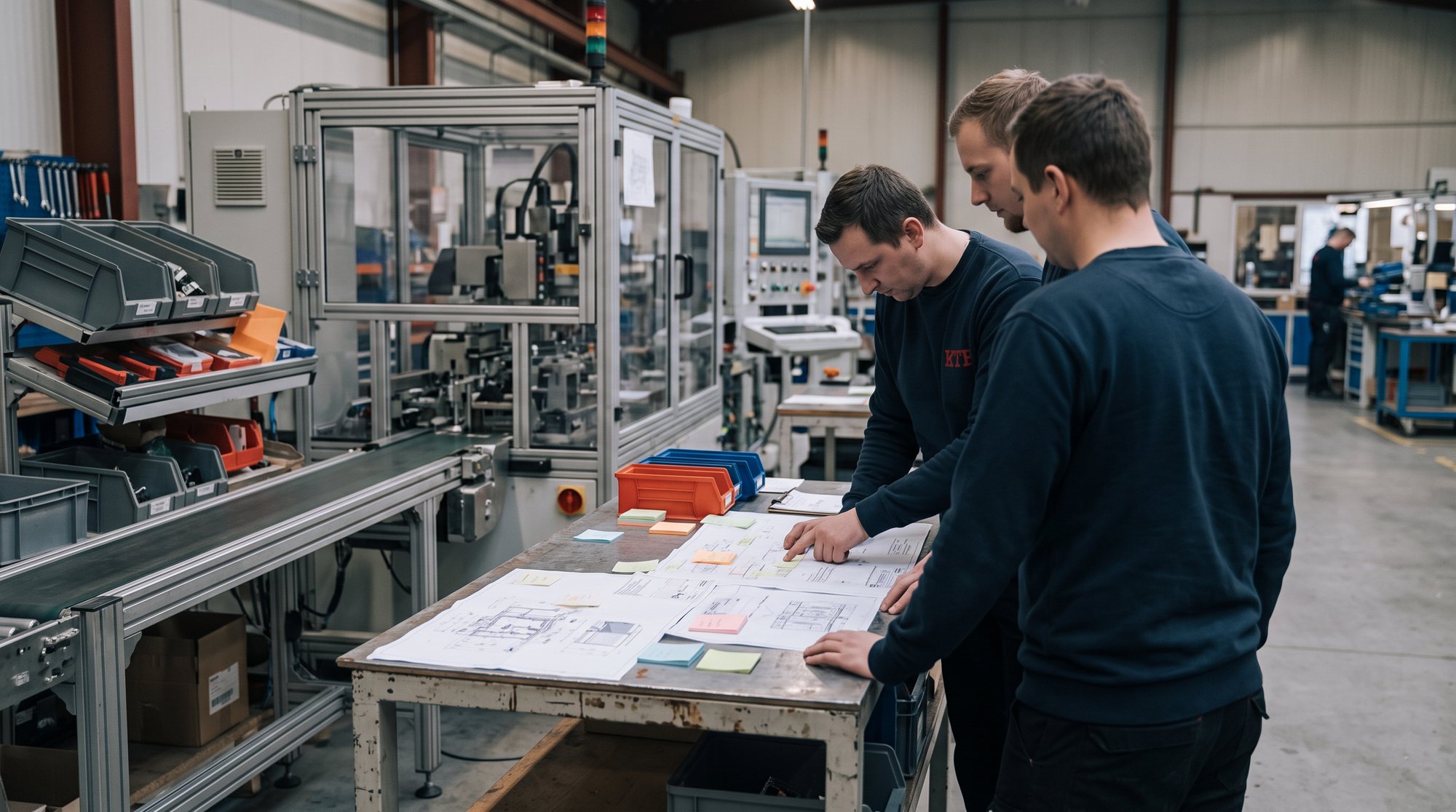
- Planning and preparation: define the scope (which equipment, which boundaries?), assemble the team, schedule the sessions. The team should include maintenance, operators, production and, where needed, electrical, safety and procurement.
- Structure analysis: break the equipment down into assemblies and components, such as pump, motor, coupling, mechanical seal, bearings.
- Function analysis: describe the function of each element: “pump delivers cooling water at rated flow”.
- Failure analysis: collect failure modes, effects and causes and link them together.
- Risk analysis: record existing prevention and detection controls and assess the risk.
- Optimisation: define additional actions, with an owner and deadline, and reassess after implementation.
- Results documentation: record and communicate the results and transfer them into the maintenance plan, spare parts strategy and work instructions.
Assessing risk: severity, occurrence, detection
For each combination of failure mode, effect and cause, the team assigns three ratings, usually on a scale from 1 to 10:
| Criterion | Question | 1 means | 10 means |
|---|---|---|---|
| Severity (S) | How serious is the effect? | barely noticeable | danger to people or the environment |
| Occurrence (O) | How likely is the cause to occur? | practically never | very often |
| Detection (D) | How reliably is the fault detected before the effect? | reliably detected | practically undetectable |
Important: for detection, a low value is good. A 10 means that the fault goes unnoticed until the effect occurs.
The risk priority number (RPN)
Traditionally, the three values are multiplied: RPN = S × O × D. The RPN therefore lies between 1 and 1,000. The higher it is, the more urgent the actions.
The RPN is simple but has a well-known weakness: identical numbers can mean very different risks. A cause with S = 10, O = 2, D = 5 gives an RPN of 100 – exactly the same as S = 2, O = 10, D = 5. In the first case a serious effect is looming, in the second a frequent but harmless fault. If you sort by RPN alone, you can overlook a serious risk.
Action priority (AP)
The AIAG/VDA FMEA Handbook therefore replaces the RPN with action priority (AP). Instead of multiplying, a table assigns each combination of S, O and D to one of three levels: high, medium or low. Severity carries the most weight, followed by occurrence, then detection.
IEC 60812 also describes other ways of prioritising risks besides the RPN, such as a criticality matrix of severity and occurrence. Decide in advance which method you will use and apply it consistently across the whole site. Whatever the method: failure effects of very high severity, for example for safety or the environment, always deserve separate consideration.
FMEA example: cooling water pump
The following fictitious example shows an extract from an equipment FMEA for a centrifugal pump in the cooling circuit. The ratings are illustrative and in practice depend on your equipment and your rating catalogues.
| Component | Failure mode | Effect | Cause | S | O | D | RPN |
|---|---|---|---|---|---|---|---|
| Mechanical seal | leaking | water in the motor, cooling down | dry running at start-up | 8 | 5 | 7 | 280 |
| Pump rolling bearing | bearing damage | noise, later seizure | insufficient lubrication | 7 | 4 | 4 | 112 |
| Motor | overheating | motor protection trips, downtime | fan cowl dirty | 6 | 3 | 3 | 54 |
| Coupling | wear on the spider/gear ring | impacts, consequential damage to bearings | misalignment | 6 | 4 | 6 | 144 |
The mechanical seal stands out: serious effect, moderate frequency and hardly any way of noticing the fault in time. Possible actions are:
- Prevention: retrofit dry-running protection, define the start-up procedure in the work instruction.
- Detection: leakage monitoring on the seal, add a visual check to the inspection round.
- Limiting the effects: stock a spare mechanical seal and a set of bearings, so the repair doesn’t have to wait for procurement.
After implementation, the team reassesses. If, for example, detection drops from 7 to 3, the RPN falls from 280 to 120. If you work with action priorities, you reclassify the new combination according to the AP table.
What the FMEA brings for maintenance and spare parts
A good FMEA doesn’t end on the form. Its results feed directly into day-to-day work:
- Maintenance plan: inspections and servicing targeted where risks are high, instead of across the board.
- Condition monitoring: vibration or temperature measurement for components with poor detectability.
- Spare parts strategy: parts with high severity and a long replenishment time go on the list of critical spare parts.
- Training: operators know the early warning signs of the most important failure modes.
How to start your first FMEA without a lot of effort
Many companies shy away from FMEA because it sounds like weeks of work. To get started, a manageable framework is enough:
- Pick one machine: ideally the one with the most or most expensive failures recently.
- Bring the fault history: the recorded failures show which failure modes have actually occurred already.
- Limit the time: several short sessions of two to three hours are more productive than a whole day.
- Use a simple tool: a spreadsheet with the columns from the example above is enough to start with. Dedicated software pays off once FMEA becomes routine on site.
After the first round you will have a prioritised list of actions. Implement the three most important ones first and reassess after a few months whether the failures have changed.
Typical FMEA mistakes
- Lone wolf instead of team: an FMEA filled in by one person at a desk misses the knowledge from operators and shift work.
- Scope too large: if you analyse the whole factory at once, you will never finish. Start with the most critical equipment.
- Ratings without a catalogue: without written criteria, every team assigns different numbers. Define rating catalogues for S, O and D.
- Actions without owners: an action without a name and a deadline won’t get done.
- Created once, never maintained: the FMEA is a living document. After modifications, new failures or operational changes, it needs to be revisited.
When critical parts are hard to get
The FMEA often shows that the biggest risk isn’t the failure itself but the time until a replacement arrives. On older equipment in particular, some parts are discontinued or only available with difficulty. In that case you should look for alternatives early – not once the plant is already down.
KTB Europe is a family business from Hamburg and has been sourcing spare parts of all brands worldwide since 1976. You can send us an enquiry with a part number, nameplate photo or description. For discontinued parts, we look for suitable alternatives. Find out more on our pages about spare parts management and discontinued parts. Related reading: how to measure failures with MTBF and MTTR and how to transfer the FMEA results into a maintenance plan .
Send us your enquiry about a specific part via the contact page.
Conclusion
FMEA is one of the most effective methods for preventing failures before they happen. It brings the knowledge of maintenance, operators and production to one table and makes risks comparable. Whether you work with the classic RPN or with action priorities, what matters is that the assessment turns into concrete actions – in the maintenance plan, in condition monitoring and in spare parts stocking. Start with a machine that is already worrying you today.
Frequently asked questions
What does FMEA mean?
FMEA stands for failure mode and effects analysis. A team systematically examines which failures can occur in a product, process or piece of equipment, what effects they have and how the risk can be reduced. The method is preventive, i.e. it works before any damage occurs.
How do you calculate the RPN?
The risk priority number is obtained by multiplying severity, occurrence and detection, each usually rated from 1 to 10. The result lies between 1 and 1,000. Because identical numbers can describe different risks, serious effects should always be considered separately.
What is the difference between RPN and action priority?
The RPN multiplies the three ratings into one number. Action priority from the AIAG/VDA FMEA Handbook uses a table to assign each combination to the levels high, medium or low. Severity carries the most weight, so serious effects don’t get lost in a low number.
Which standard applies to FMEA?
Across industries, IEC 60812 describes how to carry out an FMEA. In the automotive industry, the joint AIAG and VDA FMEA Handbook is also authoritative. Many companies outside the automotive sector also follow its seven-step approach.
Who should take part in an FMEA?
An FMEA thrives on knowledge from different areas. In maintenance, the team typically includes maintenance technicians, operators, production and, where needed, electrical, health and safety and procurement. A facilitator makes sure the method is followed and that actions are assigned owners.
About the author
Mica Duarte
Senior Procurement Specialist at KTB Europe with over 15 years of experience in global MRO sourcing and supply chain management.
LinkedIn