
6 min read
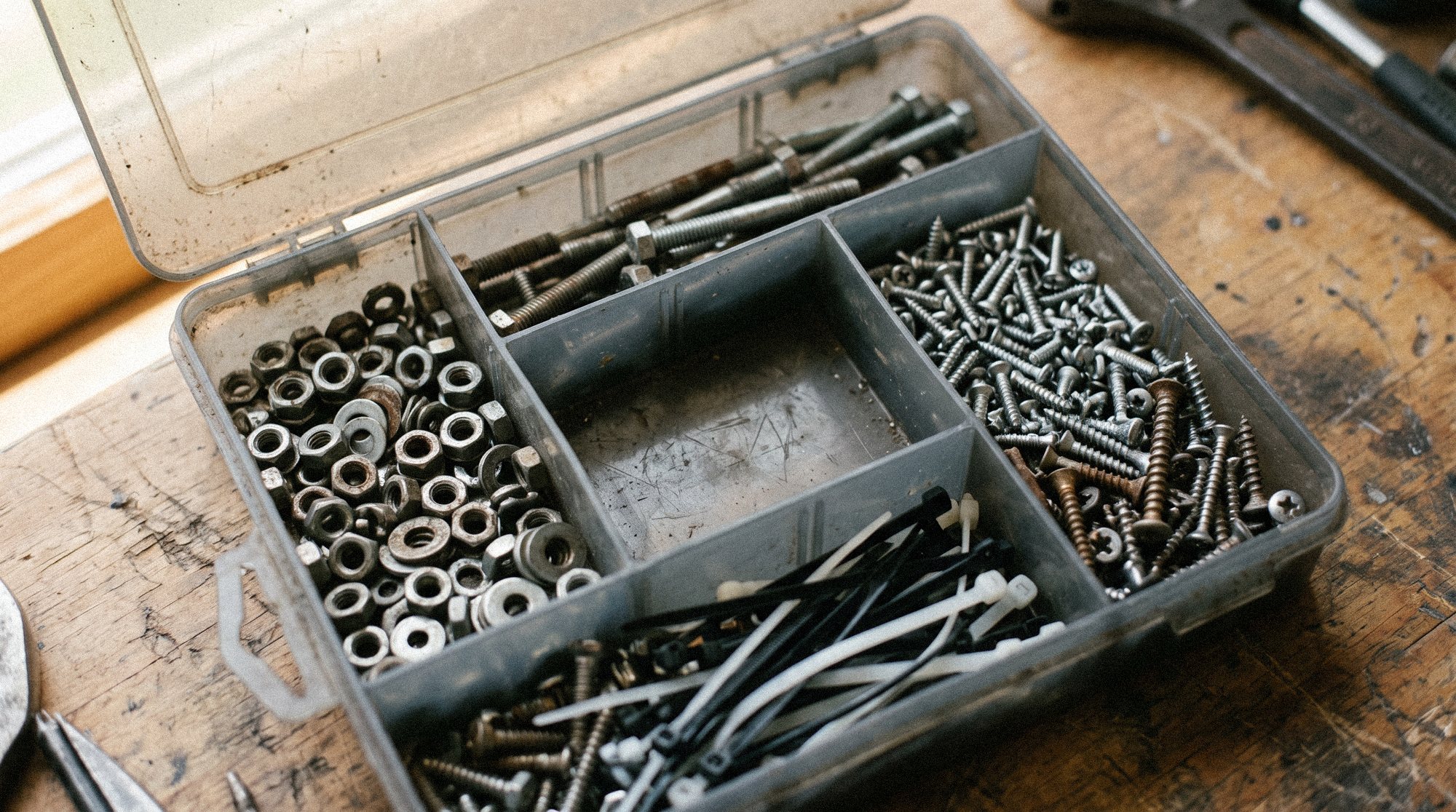
C-parts are the small parts of a business: screws, nuts, washers, cable ties, fuses, hoses, sealing rings. They account for a small share of procurement spend, but a large share of orders. That is exactly where the problem lies.
C-parts management is not about pushing down the price of a screw. It is about reducing the effort surrounding the screw. Anyone who confuses the two is making one of the following seven mistakes.
What are C-parts?
The term comes from ABC analysis. A-parts are a few items with a high share of value; C-parts are many items with a low share of value. In industry, they typically include:
- standardised parts and fasteners
- small electrical parts such as terminals, fuses and cable lugs
- seals, O-rings and hose clamps
- consumables such as adhesive tape, abrasives and cleaning agents
- basic personal protective equipment
Some companies also include simple wear parts. The boundary is fluid. What matters is the pattern: low value, frequent demand, many items.
Mistake 1: saving on the unit price
Procurement obtains three quotes for cable ties and saves a few per cent. The round of quotes took several hours. The saving amounts to a few euros a year.
That does not mean prices do not matter. But with C-parts, a price negotiation is only worthwhile if it applies to an entire range and over a longer period, for example as part of an annual contract. Individual rounds of quotes for individual items almost always cost more than they bring in. Anyone who works this out once using their internal hourly rate usually changes their priorities very quickly.
With C-parts, process costs are the real cost driver. An order goes through a requisition, approval, purchase order, goods receipt, invoice check and payment. Every step costs working time. Savings here are worth more than savings on the unit price.
With C-parts, the screw is not what is expensive. What is expensive is the path it takes through your company.
Mistake 2: too many suppliers
There is one supplier for screws, another for small electrical parts, a third for seals. On top of that come distributors that were used in emergencies and have been on the creditor list ever since. Every supplier means master data maintenance, separate terms, separate invoices.
Supplier consolidation can achieve a great deal here. The aim is not a single supplier for everything. The aim is a clear first choice per category and as little fragmentation as possible.
Mistake 3: no overview of demand
Many companies do not know which C-parts they consume and in what quantities. Orders are placed when the bin is empty. This leads to rush orders, duplicate orders and excess stock all at the same time.
Even a simple analysis of the past year shows which items are needed regularly. These items belong in a fixed system with minimum stock levels.
Mistake 4: free-text orders
“10 screws M8, stainless steel” is not an unambiguous order. What length? What head? What property class? Which standard? Free text leads to follow-up questions, incorrect deliveries and items that cannot be analysed.
For recurring C-parts, create item master data with standard, dimensions, material and surface finish. It takes time once. After that, it saves time with every order.
Mistake 5: too many variants
The store holds screws in twenty different lengths, even though five would be enough. Every variant needs a storage location, an item number and a minimum stock level. Many variants arise because design engineering and maintenance have specified different parts over the years.
Rationalising the range together with engineering reduces the number of items. Fewer items mean fewer orders, less storage space and fewer mix-ups.
Mistake 6: treating technical parts like consumables
Not every small part is non-critical. An O-ring in a hydraulic press, a fuse in a control system or a special bolt in a coupling can bring equipment to a standstill. If you treat these parts like cable ties and buy on price alone, you risk the wrong materials, the wrong tolerances and downtime.
So distinguish between genuine consumables and technically relevant small parts. The latter need clear specifications and approval by engineering.
Mistake 7: doing everything yourself
Many companies procure C-parts using the same processes as A-parts. That is like drawing up a purchase contract for every postage stamp. Yet there are models developed specifically for C-parts:
- Kanban systems: containers with fixed quantities that are automatically refilled when empty.
- Catalogues and framework agreements: fixed items on fixed terms, orderable without a round of quotes.
- External procurement partners: a partner takes over the procurement of entire categories, including across many manufacturers, and bundles orders and deliveries.
Typical scenario: the screw that took three weeks
For a repair, a maintenance technician needs ten special screws in a less common property class. The store does not have them. He writes a free-text requisition. Procurement asks about the standard. The technician is on shift and replies two days later. The regular supplier does not carry the screw. A new supplier is found, set up and approved. The order goes out, the screws arrive, and the invoice has to be matched manually because the order number is missing.
The value of the goods was a few euros. The repair was delayed by weeks. This scenario contains almost every one of the seven mistakes: free text, no master item, one more supplier, a technical small part without a specification. Processes like this are not the exception, but everyday reality in many plants.
KPIs for C-parts management
A few figures are enough to make progress visible:
- Number of suppliers for C-parts
- Number of orders per year in this area
- Share of free-text orders
- Number of active items
- Number of incorrect deliveries and follow-up questions
If these figures fall, process costs fall too. Parts prices do not even have to drop for that.
The countermeasures at a glance
| Mistake | Countermeasure |
|---|---|
| Saving on the unit price | measure and reduce process costs |
| Too many suppliers | consolidate suppliers per category |
| No overview | analyse consumption, set minimum stock levels |
| Free-text orders | create item master data |
| Too many variants | rationalise the range with engineering |
| Technical parts treated as consumables | specify critical small parts separately |
| Doing everything yourself | use Kanban, catalogues or procurement partners |
C-parts in plants abroad
C-parts management becomes particularly difficult in plants abroad. Standards differ, for example between metric and imperial threads. Local distributors do not always carry the materials and property classes specified in the European design. And anyone who orders individual small parts internationally often pays many times the value of the goods for shipping and handling. Here, it helps to bundle technically relevant small parts deliberately and procure them together with larger spare parts orders, rather than ordering them individually. For pure consumables, on the other hand, a local supplier is usually the better choice.
Where to start?
Start with a list: all suppliers from whom C-parts were ordered in the past year, with the number of orders and the volume. This list usually shows immediately where fragmentation is greatest. That is where the first step pays off.
In the second step, talk to maintenance about the technically relevant small parts. This group is usually smaller than expected, but it determines the availability of your equipment.
How KTB supports you
Since 1976, KTB Europe has been procuring everything for industrial customers, from the smallest screw to large industrial components. For C-materials, spare parts and direct materials, we put together the right supply programme and combine requirements from many manufacturers. This lets you reduce the number of your suppliers without sacrificing choice.
Find out more about the model on our pages on procurement outsourcing and cost optimisation.
Conclusion
C-parts management is not a pricing issue but a process issue. Fewer suppliers, fewer variants and fewer ordering processes save more than any price negotiation could achieve. And maintenance finds what it needs faster.
Would you like to know how much effort is tied up in your C-parts? Get in touch via our contact page .
Frequently asked questions
What are C-parts?
C-parts are low-value items that are needed frequently and in large numbers. The term comes from ABC analysis. In industry, they mainly include standardised parts and fasteners, small electrical parts, seals, consumables and basic personal protective equipment. They account for little procurement spend, but many ordering processes.
What is C-parts management?
C-parts management refers to all the measures companies use to organise the procurement of C-parts efficiently. The focus is not on the unit price but on reducing process costs. Typical tools are supplier consolidation, clean item master data, range rationalisation, Kanban systems, catalogues, framework agreements and outsourcing to external partners.
Why are process costs so high for C-parts?
Every order goes through the same sequence: requisition, approval, purchase order, goods receipt, invoice check and payment. This effort is independent of the value of the goods. With low-value C-parts and many individual orders, process costs therefore often exceed the price of the goods themselves. Consolidation and standardisation tackle exactly this.
Are all small parts non-critical?
No. An O-ring in a hydraulic press, a special retaining ring in a control system or a bolt in a coupling can bring equipment to a standstill. Technically relevant small parts like these need clear specifications covering standard, material and tolerance, as well as approval by engineering. Keep them deliberately separate from pure consumables.
About the author
Mica Duarte
Senior Procurement Specialist at KTB Europe with over 15 years of experience in global MRO sourcing and supply chain management.
LinkedIn