
6 min read
Every MRO supplier knows these enquiries. “Please quote for a motor, 4 kW.” “We need the valve from line 2, same as last time.” “Photo attached.” The photo shows a part, but no nameplate.
What follows are follow-up questions. Each one costs half a day to a full day, because answers take time to arrive. After three follow-up questions, a week has passed before there is even a quote.
This checklist shows the twelve details a spare parts enquiry needs. Not every enquiry needs all of them. But the more of them you provide, the faster and more accurate the quote will be.
Part A: What exactly are you looking for?
1. Manufacturer
The name of the manufacturer, exactly as it appears on the nameplate. Watch out for takeovers: many brands now belong to other groups. Give the name on the part, not the current group name. The supplier can make the connection itself.
2. Full part number
The complete order number with all suffixes, hyphens and version details. In automation technology in particular, variants often differ only in the last few characters. A missing suffix can mean a different voltage, a different connection or a different firmware version.
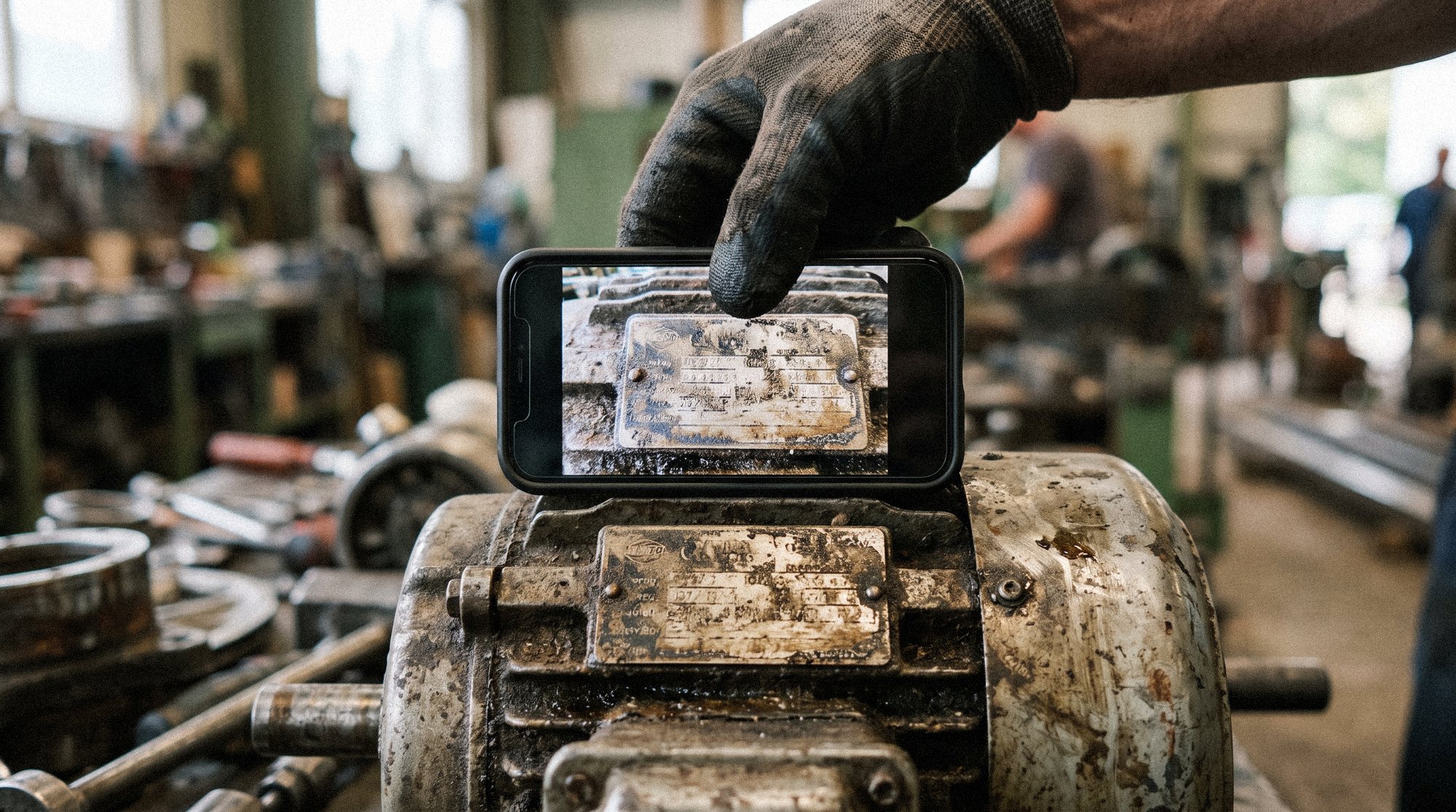
3. Photo of the nameplate
A sharp, complete photo. No reflections, no cropped edges. The photo is the most important safeguard against transcription errors. If the plate is dirty, clean it carefully before taking the photo.
4. Serial number
The serial number of the part and, if it belongs to a machine, that of the machine as well. For special versions, the manufacturer can use the serial number to trace the exact configuration.
Part B: Where and how is it used?
5. Installation location and application
In which machine, in which assembly, for which function? “Drive for the outfeed conveyor” helps more than “line 2”. The application is particularly important when alternatives are being checked.
6. Photos of the installation
One or two photos of the installed part showing connections, mounting and surroundings. These reveal the design, connection type and available space.
7. Key technical data
If the nameplate or part number is missing, technical data are the most important substitute. Depending on the part, these include, for example:
- Motors: power, voltage, frequency, speed, mounting type, shaft diameter
- Bearings: inner diameter, outer diameter, width, sealing
- Valves: function, port size, operating pressure, coil voltage
- Sensors: design, sensing distance, output, connection
- Seals: dimensions, material, medium, temperature
A good enquiry answers the follow-up questions before they are asked.
Part C: What is expected?
8. Quantity
How many pieces are needed? And is there demand for additional parts in stock? Sometimes a slightly larger quantity is cheaper per piece or saves a second order.
9. Realistic target date
When does the part need to be where? Be honest. If every enquiry is marked “urgent”, the word loses its meaning. Distinguish between downtime, planned maintenance and restocking.
10. Delivery location and country
Where is the part going? Plant, address, country. The country determines import regulations, documents and sometimes also which version of a part is permitted.
11. Alternatives allowed?
May the supplier offer an equivalent part from another manufacturer or a successor type? If so, who checks and approves it? This detail often opens up faster or cheaper routes.
12. Documents and requirements
Does the part need specific evidence, such as a mill test certificate, a certificate of origin or an EU declaration of conformity? Are there requirements for packaging or labelling? If you only mention this after the order, you risk delays.
Bonus: the right contact person
Name a person in the enquiry who can answer technical questions. Often this is not the buyer but someone from maintenance. A phone number that can be reached during the day often saves more time than any written explanation.
Template to copy
| Detail | Your entry |
|---|---|
| Manufacturer | |
| Full part number | |
| Photo of nameplate | attached: yes / no |
| Serial number part / machine | |
| Installation location and application | |
| Photos of installation | attached: yes / no |
| Key technical data | |
| Quantity | |
| Target date and reason | downtime / maintenance / stock |
| Delivery location and country | |
| Alternatives allowed? | yes / no, approved by: |
| Documents required | |
| Technical contact person |
The five most common gaps in enquiries
From a supplier's point of view, the same details are missing from enquiries again and again. If you only pay attention to these five points, you are already ahead of many others:
- Truncated part number: the suffix is missing because it is on a second line of the nameplate.
- Photo without nameplate: the part is visible, but not its identification.
- No delivery country: the quote has to be recalculated when it turns out that the part is going overseas.
- Unclear urgency: “urgent” without a date does not help anyone choose the supply route.
- Nothing said about alternatives: the supplier does not know whether it may offer a faster successor type.
Typical scenario: two enquiries, one part
Two plants enquire about the same pneumatic valve on the same day. The first sends: “Valve for line 3, please quote.” The second sends the manufacturer, full number, nameplate photo, quantity, delivery country and a note that a successor type is allowed. By the afternoon, the second plant has a quote with two options. By the afternoon, the first plant has received a follow-up question. The difference does not lie with the supplier. It lies in the enquiry.
If you only have half of it
Not all details are always available. Nameplates are worn, the documentation has disappeared, the manufacturer no longer exists. Send what you have anyway. An experienced supplier can often read more from photos, dimensions and the application than you might think. The only important thing is to say openly what is missing. Then targeted questions can be asked, rather than an unsuitable quote being produced.
Enquiry, order, delivery: the same data
The details from the enquiry should reappear in the order. It sounds obvious, but it is often forgotten. If the order only says “item 1 as per quote”, goods receipt later lacks the basis for checking. Carry the manufacturer, full part number and quantity over into the order. That way, goods receipt can compare the delivered part directly with the enquiry.
Several items in one enquiry
For maintenance shutdowns or restocking, you often enquire about many parts at once. A table with one row per item and the details above as columns helps here. Number the items and attach photos with the same number in the file name. That way, even a long list stays clear, and follow-up questions can be assigned unambiguously.
Taking photos properly: five small rules
- Photograph the nameplate head-on, not at an angle, and without flash if it reflects.
- Take one overview photo and one close-up.
- For dimensions, include a folding rule or calliper in the picture.
- Photograph connectors and connections from the front so that the pin assignment and design are recognisable.
- Send photos in their original resolution, not compressed via a messaging app.
These rules sound trivial. In practice, they often decide whether a part can be clearly identified from a photo or not.
How we work with your enquiry
At KTB Europe, you can send us the part number, the model designation or a description of the part you need by phone, by email or via our contact form. Once it arrives, we search our worldwide supplier network and come back to you with concrete options, prices and lead times. If the original part is unavailable or hard to obtain, ask us about alternatives. We have been doing this for industrial customers worldwide since 1976.
Find out more on our page on MRO procurement. You can submit your enquiry directly via our contact page .
Conclusion
Most of the time in spare parts procurement is not lost at the supplier, but in the back-and-forth beforehand. Twelve details, a good photo and a contact person who can be reached shorten this path considerably. Print out the template and put it wherever enquiries are made.
Frequently asked questions
What is the most important detail in a spare parts enquiry?
The full part number together with a sharp photo of the nameplate. The number identifies the part unambiguously, while the photo protects against transcription errors and shows suffixes that are often decisive. In automation technology in particular, variants often differ only in the last few characters of the order number.
What can I do if the nameplate is no longer legible?
In that case, key technical data, photos of the installation, dimensions and a description of the application help. The serial number of the machine can also help, because machine manufacturers can often use it to trace the installed components. Send everything you have and say openly which details are missing.
Should I allow alternatives in my enquiry?
If technically possible, yes. An equivalent part from another manufacturer or a successor type may be available faster or at a lower price. State who checks and approves alternatives technically. This allows the supplier to offer targeted options, while you keep control of the decision.
Why is the delivery location important for the enquiry?
The delivery location determines import regulations, the documents required and sometimes also the permitted version of a part, for example because of mains voltage or approvals. It also affects lead time and costs. If you only name the country after receiving the quote, you risk the quote having to be prepared again.
How do I enquire about many items at once?
Use a table with one row per item and columns for manufacturer, part number, quantity, technical data and target date. Number the items and name the photos with the same number. That way, even long lists for maintenance shutdowns stay clear, and follow-up questions can be assigned unambiguously.
About the author
Mica Duarte
Senior Procurement Specialist at KTB Europe with over 15 years of experience in global MRO sourcing and supply chain management.
LinkedIn