
7 min read
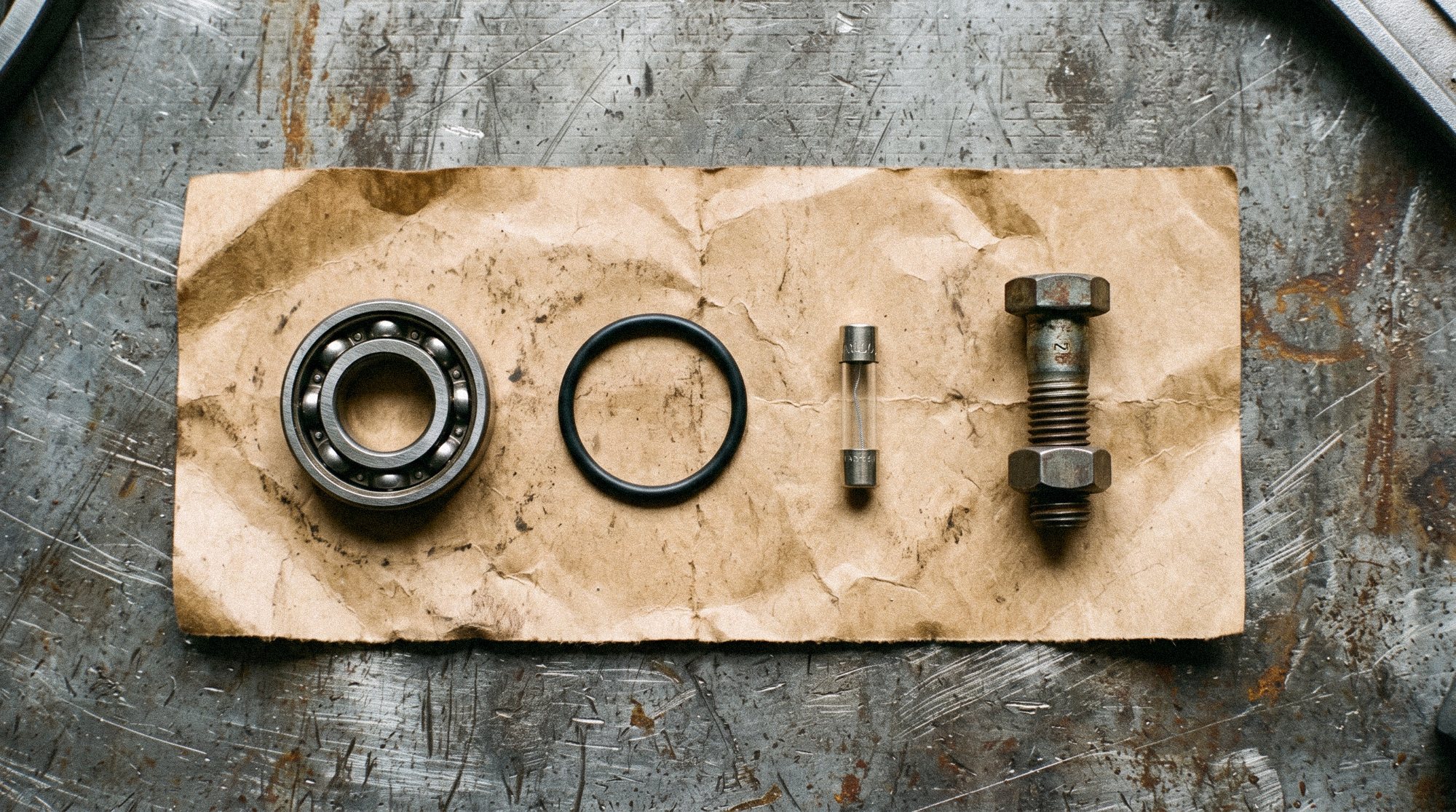
A ball bearing sometimes costs less than a lunch. If it fails in the wrong place, an entire line still stops. These are exactly the parts the abbreviation MRO refers to. They never appear in a product costing, and they never feature on a billboard. But without them, no factory runs.
In this article we explain what MRO means, which parts it covers, how MRO differs from direct materials and why procurement so often takes more work than the value of the goods would suggest.
MRO: what the three letters mean
MRO stands for maintenance, repair and operations. It covers all the parts, materials and supplies that keep plants, machines and buildings running. They do not become part of the product you sell. They make sure that product can be made at all.
In some industries, such as aviation, the ‘O’ stands for overhaul. In manufacturing, ‘operations’ has become the standard. You will also hear terms such as industrial supplies, technical supplies or maintenance materials.
The three areas in everyday practice
- Maintenance: planned work. Changing filters, re-tensioning belts, greasing bearings, replacing seals.
- Repair: unplanned work. A motor burns out, a valve sticks, a sensor delivers nonsense.
- Operations: everything that day-to-day running consumes. Lubricants, tools, personal protective equipment, cleaning agents, cable ties.
Related terms explained briefly
- Maintenance (as a discipline): According to the German standard DIN 31051, it comprises servicing, inspection, repair and improvement. MRO material is what these activities need.
- Spare part: a part that replaces a defective or worn part with the same function.
- Wear part: a spare part that wears out in normal operation, such as belts, brushes or seals.
- C-part: a low-value item that is usually consumed in high volumes, such as screws or cable ties.
Which parts count as MRO?
The list is long, and that is precisely its nature. A short selection shows the range:
- Bearings, seals, couplings and drive components
- Pneumatics and hydraulics: cylinders, valves, hoses, pumps
- Electrical and automation: sensors, contactors, frequency inverters, control modules
- Spare and wear parts for specific machines
- Standard parts and C-parts: screws, nuts, fuses
- Tools, measuring equipment, lubricants and personal protective equipment
Some of these parts cost a few cents. Others, such as a gearbox or a spindle, cost as much as a mid-range car. What they have in common: they are needed when something stops working. And then usually immediately.
Three typical MRO moments from everyday plant life
Three typical scenarios, as they occur in many plants, show what MRO looks like in practice:
- The planned shutdown: The line is down for a week of maintenance. The maintenance team has a list of eighty items. Two of them arrive late, and the shutdown is extended by a day.
- The failure on the night shift: A proximity switch on a press stops sending a signal. The part is cheap. But nobody knows whether the stores still have one, or under which number it is listed.
- The old machine: A plant from the nineties runs reliably. Until a geared motor gives up whose manufacturer was absorbed into a group long ago.
In all three cases, the part is not the problem. The problem is the time it takes for the right part to reach the right place.
MRO or direct materials? Drawing the line
Procurement broadly distinguishes between direct materials and indirect materials. The following table shows the main differences.
| Characteristic | Direct materials | MRO materials |
|---|---|---|
| Becomes part of the product? | Yes | No |
| Demand | predictable, linked to production volumes | often unplanned, fluctuating |
| Number of items | manageable | very many, often single items |
| Suppliers | few, closely managed | many, often grown over time |
| Typical risk | price and quality | availability and downtime |
The crucial difference lies in the last row. With direct materials, buyers negotiate over percentages. With MRO, it is usually about hours.
With MRO, the price of the part rarely matters. What matters is the price of the hour in which it is missing.
Why MRO procurement takes so much effort
Anyone who has worked in maintenance knows the pattern. The value of an order is small, the effort behind it is large. There are solid reasons for this.
Many items, small quantities
A plant can have thousands of different spare parts in use. Many of them are ordered once a year, some only once in a machine's life cycle. Each of these orders requires an enquiry, a quotation, an approval, a purchase order, a goods receipt and an invoice check. The process is the same as for a large order. Only the result is smaller.
Many manufacturers, many suppliers
A production line is made up of components from many manufacturers. Each has its own sales channels, its own minimum order quantities and its own lead times. Over the years, this produces a supplier list that nobody actively maintains any more.
Unclear data
Nameplates have faded. The parts list dates from commissioning. The manufacturer has renamed or discontinued the part. Often the real work starts with finding out what is actually needed.
Time pressure
Planned maintenance can be prepared. Repairs cannot. When a plant is down, a routine purchase becomes a rush order. If you only start looking for suppliers at that point, you lose time.
What good MRO procurement looks like
There is no single right way, but there are principles that work in many plants.
- Know your critical parts. Not every part deserves a place in the stores. But the parts whose failure stops a plant should be known and secured.
- Maintain your data. Manufacturer, part number, technical data and installation location belong cleanly in the master data. That saves time with every enquiry.
- Consolidate suppliers. Fewer contacts mean fewer purchase orders, fewer invoices and less coordination.
- Allow alternatives. A technically equivalent part from another manufacturer may be available sooner or cost less. But the approval must be technically sound.
- Factor in process costs. The lowest unit price is worthless if it comes with three queries, two suppliers and a week of waiting.
Who supplies MRO parts?
There are basically three routes. You buy directly from the manufacturer, through an industrial distributor or through a specialised MRO supplier that sources across manufacturers.
Buying direct works well with a few large manufacturers. Industrial distributors are strong on catalogue items available from stock. An MRO supplier with an international sourcing network helps where things get complicated: with parts from many manufacturers, with plants in several countries, with hard-to-find or discontinued parts.
KTB Europe has worked as this kind of partner since 1976. From our headquarters in Hamburg and our branches, we source spare parts, C-materials and components for industrial customers worldwide, inspect the goods in our own central warehouse and propose alternatives when the original part is unavailable or hard to obtain. You can read how this works in practice on our page on MRO procurement.
MRO as a cost factor: the bigger picture
Many companies measure MRO by purchasing volume. That falls short. The real costs are spread across several levels:
- the price of the parts,
- the process costs for enquiry, purchase order and invoice,
- the capital tied up in the spare parts store,
- and the cost of downtime when a part is missing.
If you only save on the first point, you often shift the costs to the other three. If you look at all four, you usually find more levers. More on this on our page on cost optimisation.
MRO across borders
For companies with plants in several countries, MRO becomes even more complex. The same machine stands in Germany, Mexico and China. The spare parts are the same, the supply routes are not. Locally, a part may not be available at all, or only on very different terms. On top of that come language barriers, different technical standards and import regulations.
Many plants solve this by having spare parts sent from the home country. That works, but it ties up capacity at headquarters that was actually meant for other tasks. An international sourcing partner with a presence in the relevant regions can take on this role and compare local and global sources.
Conclusion
MRO is the invisible part of production. Small parts, many suppliers, unclear data and time pressure make procurement demanding. If you know your critical parts, maintain your data and consolidate suppliers, you gain one thing above all: calm on the shop floor.
Looking for a specific part or want to simplify your MRO procurement? Send us the part number or a description via our contact page. We will get back to you with concrete options.
Frequently asked questions
What does MRO mean?
MRO stands for maintenance, repair and operations. It refers to all the parts and materials that keep plants and machines running without becoming part of the product sold. These include spare and wear parts, standard parts, tools, lubricants and personal protective equipment.
What is the difference between MRO and direct materials?
Direct materials go into the end product, such as sheet steel into a housing. MRO material keeps production running but is not built in. Direct materials are usually easy to plan and linked to production volumes. MRO demand, by contrast, often arises unplanned, in small quantities and spread across many different items and manufacturers.
What are examples of MRO parts?
Typical MRO parts are ball bearings, seals, V-belts, couplings, pneumatic valves, hydraulic hoses, sensors, contactors and frequency inverters. Add to that standard parts such as screws and fuses, tools, measuring equipment, lubricants and protective equipment. Larger components such as gearboxes, motors or pumps also count when they serve as replacements.
Why is MRO procurement so time-consuming?
Because many different items are ordered in small quantities from many manufacturers. Each order goes through the same process as a large purchase. Add incomplete part data, discontinued items and time pressure during breakdowns. Process costs are therefore often close to the value of the goods, or even higher.
Is it worth outsourcing MRO procurement?
That depends on your structure. If your plant has many manufacturers, many small orders or sites in several countries, a specialised MRO partner can bundle enquiries, approach suppliers worldwide and check alternatives. That takes the load off procurement and maintenance. With a few easily planned items, going directly to the manufacturer is often enough.
About the author
Mica Duarte
Senior Procurement Specialist at KTB Europe with over 15 years of experience in global MRO sourcing and supply chain management.
LinkedIn