
8 min read
An agitator has been running for decades with a bronze bush on its shaft. During the overhaul, someone suggests switching to a ball bearing: “It’s more modern and lasts longer.” A few weeks later the bearing position starts to hum, and the new solution fails sooner than the old bush ever did.
The reverse happens just as often. A machine gets a plain bearing bush where the designer specified a rolling bearing, simply because the rolling bearing isn’t to hand. The bush runs hot, because the lubrication was never designed for sliding contact.
Plain bearings and rolling bearings do the same job: they guide a shaft and transmit forces. But they work on completely different principles. This article explains the difference, sets out the benefits and limits of both types and helps you make the right call when replacing a bearing.
The basic principle: sliding versus rolling
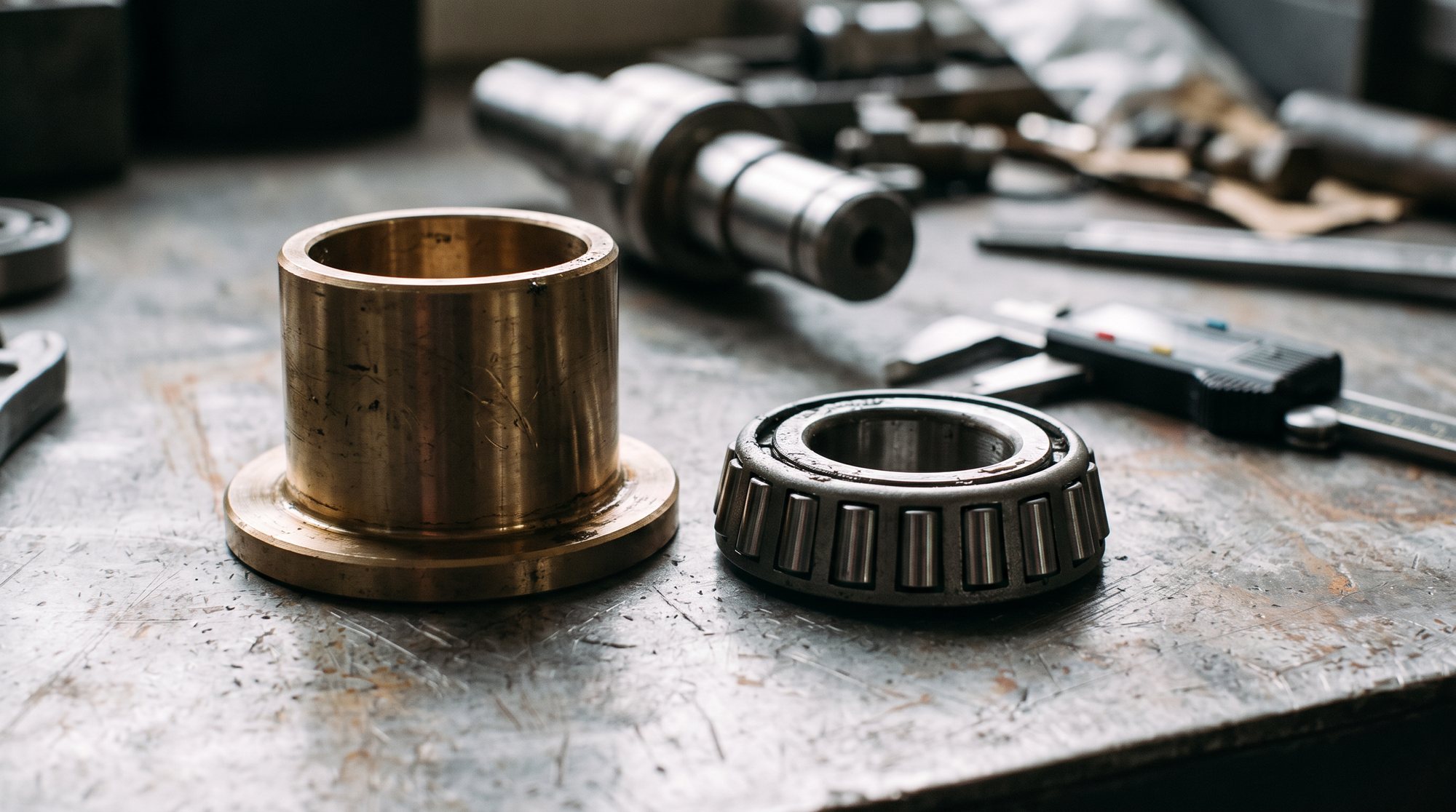
In a Plain bearing , the shaft slides directly inside a bearing shell or bush. Ideally, a load-carrying film of oil or grease separates the two surfaces. In maintenance-free plain bearings, a material with good sliding properties takes on this role, for example a PTFE layer or an oil-impregnated sintered metal.
In a Rolling bearings , rolling elements roll between an inner ring and an outer ring. Instead of sliding friction, you mostly get rolling friction, which is considerably lower. A cage keeps the rolling elements spaced apart. The best-known rolling bearing is the ball bearing, but there are also numerous roller bearings.
Almost everything else follows from this difference: behaviour at start-up, sensitivity to shock and dirt, the installation space required and the way the bearings wear.
Rolling bearings: the main types
Rolling bearings are largely standardised. The boundary dimensions of radial bearings are defined in ISO 15, and the calculation of basic rating life in ISO 281. That is why rolling bearings with the same designation from different manufacturers are usually interchangeable. The main types of rolling bearing:
- Deep groove ball bearings: the all-rounder for moderate radial loads and limited axial loads, high speeds and low friction. Typical in electric motors, pumps and fans.
- Angular contact ball bearings: take combined radial and axial loads, often fitted in pairs, for example in spindles.
- Cylindrical roller bearings: high radial load capacity; depending on the design, they act as non-locating bearings that allow axial displacement.
- Tapered roller bearings: for high combined loads, typical in wheel bearings and gearboxes, mounted in opposed pairs and adjusted against each other.
- Spherical roller bearings: high load capacity and self-aligning, so they compensate for misalignment. Common in conveyors, crushers and fans.
- Needle roller bearings: very low cross-section, for tight radial installation space.
- Thrust bearings: for purely axial loads, available as ball or roller versions.
Plain bearings: designs and materials
Plain bearings are less uniform than rolling bearings. They are more often designed for the specific machine. Broadly, there are three groups.
Hydrodynamic plain bearings
The rotating shaft draws oil into a wedge-shaped gap and builds up its own load-carrying pressure. Above a certain speed, the shaft floats on the oil film and the surfaces no longer touch. At start-up and run-down, however, there is mixed friction and therefore wear. You will find these bearings in large turbines, generators, compressors and heavy electric motors.
Hydrostatic plain bearings
An external pump forces pressurised oil into the bearing, so the shaft floats even at standstill. This is complex, but worthwhile for very slow, heavily loaded or high-precision bearing arrangements, such as in large machine tools or telescopes.
Low-maintenance and maintenance-free plain bearings
This is the group you will meet most often in maintenance: bushes made of bronze, sintered bronze, plastic or composite materials with a sliding layer. They sit in joints, hinges, levers, rollers, product-lubricated pumps and many slow-running mechanisms. Classic materials for lubricated bearings also include white metal (Babbitt) on a steel backing shell, and brass.
Plain bearing or rolling bearing: the differences at a glance
| Criterion | Plain bearing | Rolling bearings |
|---|---|---|
| Friction at start-up | high (mixed friction), except hydrostatic | low |
| Shock and vibration | good, the lubricant film dampens | sensitive, risk of indentations in the raceways |
| Radial installation space | small, often just a thin bush | larger due to rings and rolling elements |
| Noise | very quiet | audible running noise, increases with wear |
| Lubrication | critical, oil supply often complex | usually simple, often grease or lubricated for life |
| Contamination | tolerant, depending on material | sensitive to particles |
| Standardisation and interchangeability | mostly machine-specific | largely standardised, interchangeable across manufacturers |
| Service life | theoretically very long in the full-film (hydrodynamic) regime, otherwise wear | calculable fatigue life to ISO 281 |
| Split design | easily possible, fitting without removing the shaft | special designs only |
Plain bearings: benefits and limits
The key advantages of plain bearings show up where rolling bearings reach their limits:
- Damping: the lubricant film absorbs shock and vibration. That is why presses, crushers and heavy crank drives often rely on plain bearings.
- Compact installation space: a bush needs only a few millimetres radially.
- Quiet running: there are no rolling elements being over-rolled, so there is hardly any running noise.
- Split bearings: on large shafts, the bearing shell can be replaced without removing the shaft.
- Robust under slow oscillating movement: in joints and pivot axles, rolling bearings suffer from false brinelling, whereas plain bearings cope well.
The limits: wear occurs at start-up until a lubricant film has built up. If the oil supply fails, a hydrodynamic bearing can seize within a short time. Plain bearings also usually have more bearing clearance. They are only suitable for very precise shaft guidance in special designs.
Rolling bearings: benefits and limits
Rolling bearings are the standard in most machines, and for good reason:
- Low friction even at start-up, good for frequent starting and stopping.
- Simple lubrication, often with grease; many bearings are sealed and lubricated for life.
- Standardised dimensions: a 6205 deep groove ball bearing has a 25 mm bore, 52 mm outside diameter and 15 mm width from every manufacturer.
- Calculable: basic rating life can be estimated from load and speed using ISO 281.
- Precise guidance with little or even preloaded bearing clearance.
The limits: rolling bearings are sensitive to shock, contamination, misalignment and incorrect fitting. Their service life is limited by material fatigue. With large shaft diameters they become heavy and take up a lot of radial space. To learn how incipient damage announces itself, read our article Ball bearing failing? 7 signs of bearing failure.
Which bearing when? Typical applications
There is no simple rule of thumb. But this guidance helps in practice:
- Rolling bearings suit electric motors, pumps, fans, gearboxes, spindles and conveyor rollers, i.e. wherever there are moderate loads, varying speeds and frequent starts.
- Hydrodynamic plain bearings suit large, fast, continuously running shafts with a stable oil supply, such as turbines, large compressors and large generators.
- Maintenance-free plain bushes suit joints, levers, pivot axles, guides and slow-running rollers, especially where there is dirt, moisture or no way to lubricate.
- Product-lubricated plain bearings suit pumps in which the pumped medium itself provides lubrication, such as canned motor pumps or magnetic drive pumps.
Example: the conveyor roller in a wet area
A conveyor roller in a washdown area keeps failing because water gets into the rolling bearing despite the seal, and the raceways corrode. A plastic plain bush tolerates water much better. Whether the switch makes sense, however, depends on load, speed and shaft material. This assessment belongs in the hands of the design department or the manufacturer.
Changing bearing type? Check first, then replace
Switching from a plain to a rolling bearing or vice versa is not a simple replacement but a design change. Before you switch, these points should be clarified:
- Installation space: will a rolling bearing even fit in the bore without modifying the housing or shaft?
- Shaft: plain bearings need a hard, finely finished shaft surface. Rolling bearings need suitable seats with a defined tolerance.
- Loads and shocks: can the new bearing withstand the peak loads, not just the rated load?
- Lubrication: is the existing lubrication suitable for the new principle, or does it need to be changed?
- Axial location: where is the shaft located axially, and is a non-locating bearing needed?
- Documentation: has the change been approved and updated in the drawing and spare parts list?
If you cannot answer these questions with confidence, it is better to stick with the original bearing type when replacing.
What to specify when ordering a replacement
For rolling bearings
- the complete bearing designation including all suffixes, for example for sealing (2RS, 2Z), internal clearance (C3) or cage material
- the manufacturer, if known, and photos of the markings on the ring
- if the designation is illegible: bore, outside diameter and width in mm
- operating conditions such as temperature, speed or environment, if a special version is suspected
For plain bearings
- inside diameter, outside diameter and width; for flanged bushes also flange diameter and flange thickness
- material, if known, or a photo of the sliding surface
- lubrication grooves, lubrication holes and the split on wrapped bushes
- the mating part, i.e. shaft material and surface finish
- the drawing number or the machine’s spare part number, if available
With plain bearings in particular, the spare part number from the machine documentation often helps more than any dimension, because fit and material are defined there. You will find a complete overview in our checklist for spare parts enquiries.
When the bearing is hard to get
Standard rolling bearings are usually readily available. Things get difficult with special designs, bearings with unusual suffixes, older machines and machine-specific plain bearing bushes. KTB Europe is a family business from Hamburg and has been sourcing spare parts of all brands worldwide since 1976. You can send us the bearing designation, a photo of the machine’s nameplate or a description with dimensions. If the original part has been discontinued, we look for suitable alternatives.
Find out more on our page on MRO procurement and discontinued parts. You can send your enquiry directly via the contact page .
Conclusion
Plain bearings and rolling bearings are not competitors but tools for different tasks. Rolling bearings score with low start-up friction, standardisation and simple lubrication. Plain bearings play to their strengths with shock loads, limited space, large shafts and difficult environments. When replacing, the rule is: same bearing type, complete designation, careful measurements. Changing the principle is a design decision and needs to be checked and documented.
Frequently asked questions
What is the main difference between a plain bearing and a rolling bearing?
In a plain bearing, the shaft slides on a lubricant film or a sliding layer inside a bush. In a rolling bearing, balls or rollers roll between two rings. This gives them different strengths: rolling bearings have low start-up friction, while plain bearings dampen shocks and need less installation space.
What are the advantages of a plain bearing?
Plain bearings dampen shock and vibration, run very quietly and are radially compact. Large plain bearings can be split and replaced without removing the shaft. Maintenance-free bushes also often cope better than rolling bearings with dirt, moisture and slow oscillating movements.
What types of rolling bearing are there?
The main types are deep groove ball bearings, angular contact ball bearings, cylindrical roller bearings, tapered roller bearings, spherical roller bearings, needle roller bearings and thrust bearings. They differ mainly in which loads they carry, how much installation space they need and whether they can compensate for misalignment.
Can I simply replace a plain bearing with a ball bearing?
Only after a technical review. Changing the bearing type affects installation space, shaft seat, lubrication, axial location and behaviour under shock loads. It is therefore a design change that should be approved and documented. If in doubt, stick with the original bearing type when replacing.
What information does a supplier need for a plain bearing bush?
The key details are inside and outside diameter, width and, for flanged bushes, the flange dimensions. Add the material, lubrication grooves or holes and the shaft material. The spare part number from the machine documentation is especially helpful, because fit and material are defined there.
About the author
Mica Duarte
Senior Procurement Specialist at KTB Europe with over 15 years of experience in global MRO sourcing and supply chain management.
LinkedIn