
8 min read
Monday morning, a walk round the shop floor. The conveyor drive sounds different from usual. Not a loud screech, more a quiet, steady grinding. The motor is running, production is running. So it gets noted down and put off.
Three weeks later the conveyor is at a standstill. The bearing has seized, the shaft is scored, and the right ball bearing is not on the shelf. A small noise has turned into unplanned downtime.
Bearing failure almost always announces itself. The only question is whether anyone recognises the signals. This guide covers the seven most important signs, how to check them and what to specify for the replacement so that the new bearing really fits.
How bearing failure develops
A rolling bearing is designed for a specific service life. The basic rating life according to ISO 281, known as the L10 life, is the number of revolutions or operating hours that 90 % of a sufficiently large group of identical bearings reach or exceed under identical conditions. A single bearing can therefore fail earlier – and it does so especially when the conditions are not right.
Genuine material fatigue is rarely the reason. Far more often the cause lies outside the bearing:
- Lubrication: too little, too much, the wrong grease or contaminated lubricant
- Contamination: dust, swarf or water get in through damaged seals
- Fitting: bearing driven on with a hammer through the rolling elements, wrong fit, tilting
- Alignment: misalignment between motor and gearbox, bearing positions under strain
- Current passage: bearing currents, especially on motors driven by a frequency inverter
- Standstill damage: vibration from the surroundings while the machine is idle
The ISO 15243 standard groups rolling bearing damage patterns into six main categories: fatigue, wear, corrosion, electrical erosion, plastic deformation, and fracture and cracking. This classification helps later on with root cause analysis – more on that below.
The 7 signs of bearing failure
1. Changed running noise
A healthy ball bearing runs quietly and evenly. Listen for changes compared with the usual sound. Typical noise patterns are:
- Grinding or rumbling: a sign of damaged raceways or contamination
- Periodic knocking or clicking: often localised damage, such as spalling on a raceway
- High-pitched whistling or singing: frequently inadequate lubrication or too little internal clearance
- Irregular scratching: foreign particles in the bearing
A simple aid is a mechanic’s stethoscope. Comparison is what matters: listen to the same bearing positions on identical machines. The difference often tells you more than the absolute sound.
2. Rising vibration
Vibration is the most reliable early warning signal. Bearing damage generates shock pulses whenever a rolling element passes over a damaged spot. These pulses occur at characteristic frequencies that can be calculated from the bearing geometry and the speed – separately for the outer ring, inner ring, rolling elements and cage.
Vibration analysis using the envelope method often detects such damage weeks or months before you can hear it. To start with, though, a trend is enough: measure regularly at the same points, in the same direction, under comparable load. If the value rises clearly above your own baseline measurement, take a closer look.
3. Higher bearing temperature
A bearing that runs warmer than usual has a problem. Common causes are inadequate lubrication, over-greasing, too tight a fit or an over-tightened seal. Always measure with an infrared thermometer at the same spot on the bearing housing and compare with earlier readings or with the same bearing position on a sister machine.
Note: immediately after regreasing, the temperature often rises briefly until the grease has distributed itself. That is normal. If it stays high, it is not.
4. Play in the shaft
With the machine stopped and locked out, you can check whether the shaft moves radially or axially more than usual. Noticeable play points to wear on the raceways and rolling elements, or to a loosened bearing seat on the shaft or in the housing. Neither belongs in a running plant.
5. Unusual lubricant
The grease reveals a great deal about the condition of the bearing. During servicing, check its colour and consistency:
- dark, almost black grease: overheating or wear debris
- shiny metallic particles: material loss from the raceway or cage
- milky or watery grease: water ingress
- hardened, crumbly grease: ageing, relubrication interval too long
6. Leaking grease or damaged seals
If grease is escaping from a bearing position, either too much has been added during regreasing or the seal is damaged. In the second case, the path is open in the other direction too: dirt and moisture get into the bearing. A defective seal is therefore not a cosmetic issue but often the start of bearing failure.
7. Stiff rotation and higher current draw
If a shaft is hard to turn by hand or turns jerkily, that is a clear sign. In operation the same effect shows up indirectly: the drive needs more current for the same work. If you log a motor’s current draw via the control system or the frequency inverter, you will spot a gradual increase earlier than any ear.
Reading damage patterns correctly after removal
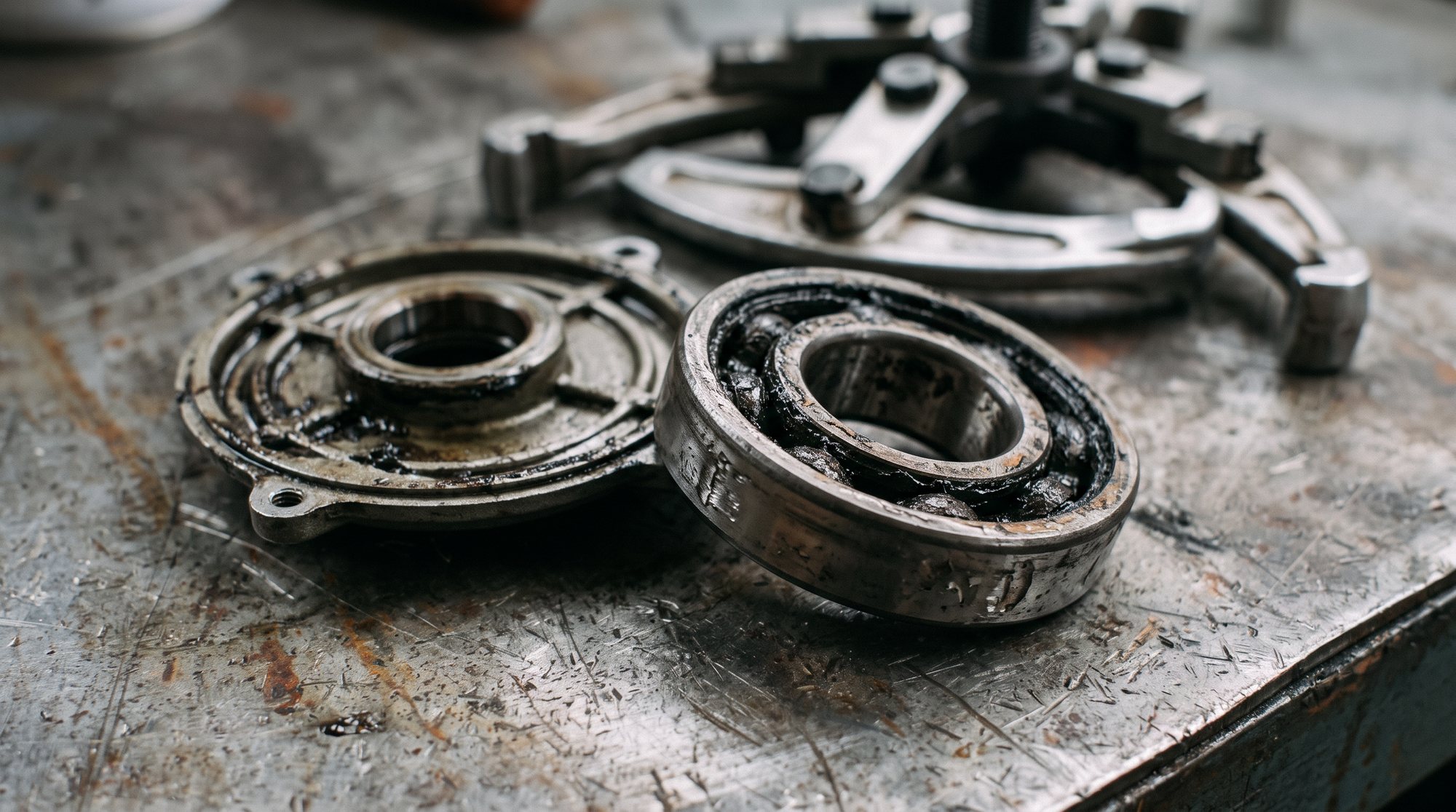
Once the bearing is out, do not throw it away straight away. The damage pattern shows why it failed. If you simply swap it without eliminating the cause, you are building in the next failure at the same time.
| Damage pattern | Typical cause | What you should check |
|---|---|---|
| Flaking in the raceway | Fatigue, often accelerated by overload or contamination | Load, lubrication, seal |
| Fluting across the raceway | Current passage, electrical erosion | Earthing, bearing insulation, inverter operation |
| Indentations at rolling element spacing | Plastic deformation from impact during fitting | Fitting tools and procedure |
| Dull, worn running surfaces | Wear from particles or inadequate lubrication | Cleanliness, relubrication interval |
| Rust or dark spots | Corrosion from moisture or aggressive media | Seal, storage during standstill |
| One-sided running track | Misalignment or skewing | Shaft alignment |
| Cracks or broken rings | Too tight a fit, impact, overload | Shaft and housing fit |
Photograph the outer ring, inner ring and rolling elements before you dispose of the bearing. These images are valuable for your own root cause analysis and also help if you consult a bearing specialist.
When does the bearing have to come out?
Not every sign means an immediate shutdown. A sensible decision depends on how critical the machine is and how quickly its condition is deteriorating:
- Slight anomaly, stable trend: shorten the measuring interval, have a replacement bearing ready, schedule the swap for the next planned shutdown.
- Clear rise in vibration or temperature: plan the replacement promptly, clarify the cause beforehand.
- Audible knocking, severe heat, noticeable play: if possible, shut the machine down immediately in a controlled manner. A bearing that seizes often damages the shaft and housing as well.
The biggest lever lies in the first point. If you detect bearing failure early, you can plan the replacement instead of reacting to the breakdown. That is exactly what predictive maintenanceis about: using condition data to have spare parts available in good time.
Typical mistakes when replacing a bearing
- Impact through the rolling elements: the fitting force always goes on the ring with the interference fit, never through the balls.
- Heating with an open flame: bearings are heated evenly with induction heaters. A flame damages the microstructure and the seals.
- Wrong internal clearance: a bearing with normal clearance instead of the specified larger C3 clearance can run too tight in operation.
- Too much grease: a bearing packed full generates churning and heat. Stick to the quantity specified by the manufacturer.
- Cause not eliminated: without a new seal, corrected alignment or better earthing, the new bearing will also fail prematurely.
What to specify when ordering a replacement
The bearing designation is usually marked on the outer ring or the side face. Copy it in full, with all suffixes. An example: in 6205-2RS C3 , 6205 stands for a deep groove ball bearing with a 25 mm bore, 52 mm outside diameter and 15 mm width. “2RS” means contact seals on both sides, “C3” an internal clearance greater than normal. A 6205-2Z with shields has the same dimensions but is not the same bearing.
For an unambiguous enquiry you need:
- the complete bearing designation including all suffixes
- the manufacturer, if legible
- if the designation is illegible: bore, outside diameter and width, measured with a vernier calliper
- type of sealing: open, shields or seals
- special features such as internal clearance, cage material, high-temperature grease or electrically insulated design
- installation location and machine, and for motors also the motor nameplate
Find out more about a complete enquiry in our checklist for spare parts enquiries.
When the right bearing is not on the shelf
Standard bearings are usually readily available. It gets harder with special designs, bearings from older machines or types that a manufacturer no longer produces. KTB Europe is a family business from Hamburg and has been sourcing spare parts of all brands worldwide since 1976. Send us the bearing designation, a photo or the measured dimensions. If the original part is no longer available, we look for an equivalent alternative.
Find out more on our page on MRO procurement and spare parts management. You can send your enquiry directly via the contact page.
Conclusion
Bearing failure rarely happens overnight. Noise, vibration, temperature, play, lubricant, seal and current draw give early warnings. If you check these seven signals regularly, examine the removed bearing and eliminate the cause, you will extend running time considerably. And if you note down the bearing designation in full, you will have the right spare part in your hands sooner.
Frequently asked questions
What does a failing ball bearing sound like?
Typical sounds are grinding, rumbling, periodic knocking or a high-pitched whistle. What matters is the change compared with the usual running noise. Comparing it with an identical bearing position on another machine helps with the assessment.
Can you keep running with bearing damage?
With slight anomalies and a stable trend, the replacement can often be postponed until the next planned shutdown, provided you monitor closely. With knocking, severe heating or noticeable play, you should shut the machine down in a controlled manner. A seized bearing often damages the shaft and housing as well.
What does C3 mean on a ball bearing?
C3 stands for a radial internal clearance that is greater than normal clearance. It is used in electric motors, for example, because the shaft and inner ring heat up more in operation than the outer ring. A replacement bearing should have the same internal clearance as the original.
How do you recognise bearing damage caused by electric current?
Electrical erosion often shows up as a fine, regular fluting pattern across the raceway, sometimes also as a dull, grey running track. It frequently occurs on motors driven by a frequency inverter. Remedies are good earthing, electrically insulated bearings or measures against bearing currents.
What are the most common causes of bearing failure?
The cause usually lies outside the bearing: wrong or missing lubrication, ingress of dirt, fitting errors and misalignment. Pure material fatigue at the end of the service life is less common. That is why it pays to take a close look at the removed bearing before disposing of it.
About the author
Mica Duarte
Senior Procurement Specialist at KTB Europe with over 15 years of experience in global MRO sourcing and supply chain management.
LinkedIn