
6 min read
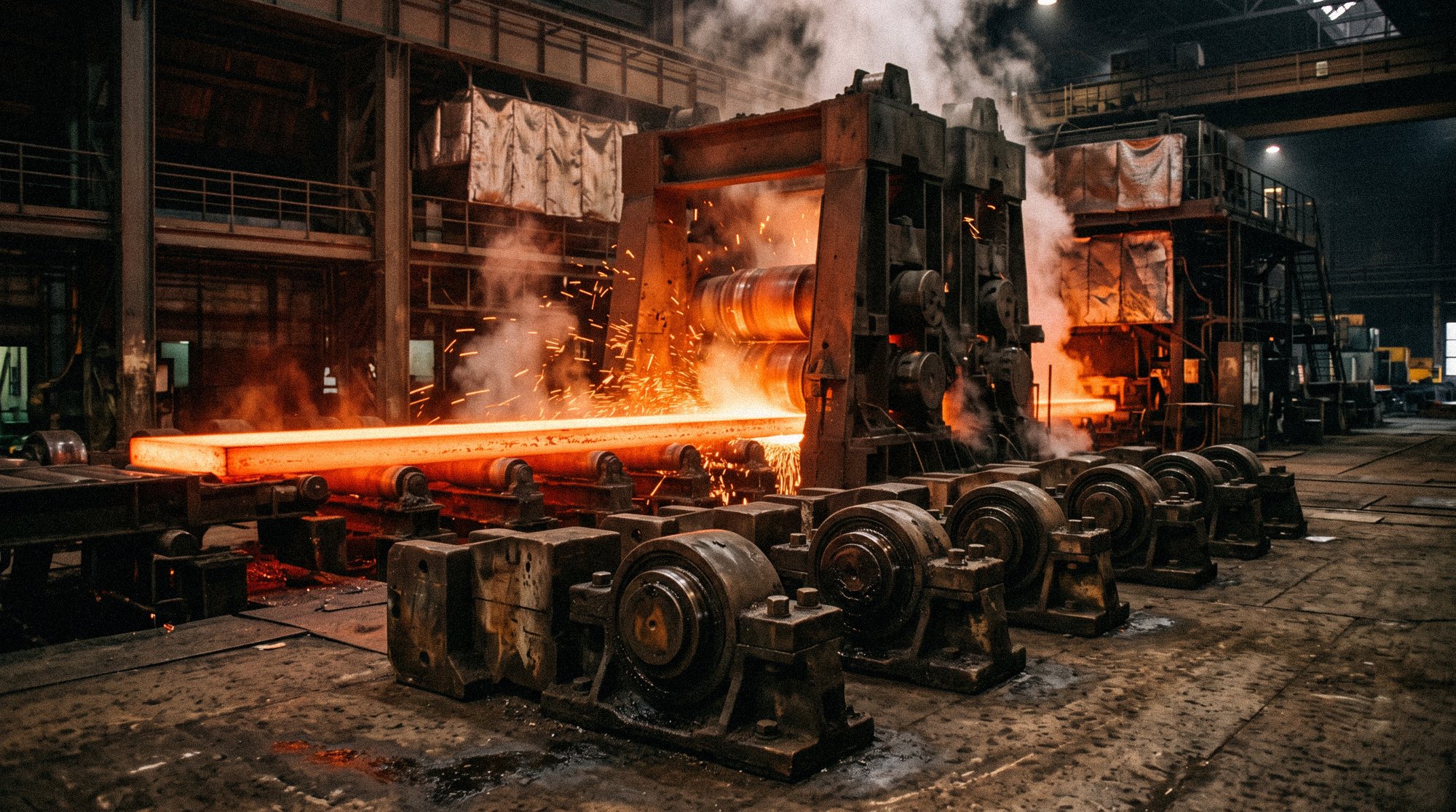
Anyone who walks into a hot strip mill for the first time never forgets the moment. A glowing slab races through the stands, water hisses into steam, the floor vibrates. What happens there is a show of mechanical force. And every part that withstands these forces will one day become a spare part.
Steelworks place demands on spare parts supply that differ sharply from other industries. This article shows why, and what procurement and maintenance can take from it.
What makes a steelworks different
Extreme conditions
High temperatures, cooling water, scale, dust, shocks and vibration put every component under strain. Bearings, seals, rollers and couplings wear faster and less predictably than in a clean assembly hall. What lasts for years on a packaging line can be due for replacement here after a few weeks.
Large components
Rolls, roll chocks, multi-row roll neck bearings, gearboxes, cardan shafts, large electric motors: many spare parts in a steelworks weigh tonnes and are not made in series. Their lead times are long, their prices high, their storage demanding.
Continuous processes
A blast furnace or a continuous caster cannot simply be stopped today and restarted tomorrow. Unplanned downtime ripples through upstream and downstream plants. The cost of a failure is correspondingly high.
Mixed plant generations
In many steelworks, equipment from several decades stands side by side. A modernised stand with new automation next to a coiler whose drive has been running for decades. On top of that, the industry’s plant builders have merged over the years. Spare parts for older equipment are often hard to trace.
In a rolling mill, the most expensive spare part is not the heaviest. It is the one that is missing on the day of the failure.
Spare part groups at a glance
| Group | Examples | Typical challenge |
|---|---|---|
| Large components | Rolls, gearboxes, cardan shafts, large motors | long lead time, high capital tie-up |
| Bearings and seals | multi-row roll neck bearings, roller bearings, seal kits | high, fluctuating wear |
| Strand guide and roller tables | Rollers, bearings, couplings, drives | large quantities, heat and water |
| Hydraulics | Cylinders, servo valves, pumps | precision, cleanliness, special versions |
| Electrics and automation | Drives, controllers, sensors, measuring equipment | discontinuations, compatibility |
| Wear parts | Guides, scrapers, nozzles, wear plates | consumption in large volumes |
Large components: plan strategically
For large components there is a simple rule: if you only order once they break, you have already lost. Lead times for custom-built parts can run to many months. That is why steelworks need a dedicated strategy for these parts:
- Criticality analysis: Which large components can stop a line and have no substitute?
- Reserve stock: For the most important parts, a spare belongs on site, even if it is expensive.
- Pooling: Where a group runs several plants or identical lines, a shared spare can make sense.
- Repair: Many large components can be overhauled. A cycle of installed part, spare and part under overhaul secures availability.
- Condition monitoring: Vibration analysis, temperature measurement and oil analysis help detect failures early and trigger purchases in good time.
Bearings and wear parts: volume and quality
A rolling mill consumes bearings, seals and wear parts in large quantities. This is less about single items and more about reliable supply on good terms. Framework agreements with call-offs, agreed minimum stock levels and a clear specification help.
Quality matters. The bearing market has counterfeits, and with large bearings in particular the damage caused by an inferior part is enormous. Buy through reliable channels and have the goods inspected before installation. KTB inspects procured parts for quality and quantity in its central warehouse. Find out more on our inspection.
Electrics and automation: the obsolescence problem
The mechanics of a rolling mill last for decades. The automation does not. Manufacturers discontinue controllers, drives and measuring equipment after a few years. In older plants this is a permanent issue.
Three strategies have proven themselves:
- Inventory: Which automation components are in use, and what is their status?
- Safeguarding: Secure critical, discontinued parts through a last time buy or remaining stock from the market.
- Planned modernisation: Schedule retrofits for shutdowns before a failure dictates the timing.
You can find more on this topic on our page on discontinued spare parts.
Hydraulics: precision in harsh conditions
Modern rolling stands control the roll gap position hydraulically, often with servo valves. These components are precise, sensitive to contamination and often installed in special versions. For spare parts supply, this means: the exact type designation including all options, clean storage, and for repairs a partner who brings the valves back to specification.
Typical scenario: the cardan shaft
On a rolling stand, a cardan shaft shows wear on its universal joints. Maintenance plans the replacement for the next shutdown. A spare shaft is in stock. The cross-check reveals: the spare dates from before a conversion, and the flange no longer fits. A new shaft from the manufacturer has a long lead time.
The solution is a combination: the spare shaft is adapted, and the old shaft is sent for overhaul. Afterwards, all large components in stock are checked against the current state of the plant. Several parts turn out to be outdated. A typical finding when stores and plant have been managed separately for years.
The planned shutdown as an opportunity
Steelworks schedule regular shutdowns for roll changes, inspections and major repairs. These dates are the best opportunity to put spare parts supply in order. Before every shutdown, check which large components will be replaced, whether the spares fit and which removed parts will go for overhaul. After the shutdown, the used reserve stock goes straight back on the order list, not only when the next spare is needed.
Checklist for spare parts supply in a steelworks
- Large components assessed by criticality and spares defined
- Reserve stock regularly checked against the current plant configuration
- Repair cycles established for large components
- Framework agreements for bearings, seals and wear parts
- Quality inspection for bearings and safety-relevant parts
- Discontinuation status of the automation known
- Retrofits scheduled for planned shutdowns
- Supply channels clarified for components from merged or defunct plant builders
Working with plant builders
For machine-specific parts, the plant builder remains an important partner. But not every part of a rolling line has to go through them. Bearings, couplings, motors, hydraulic components and automation modules usually come from suppliers and can also be sourced directly. A clear distinction helps: what is the plant builder’s own design, and what is a bought-in part? For bought-in parts, additional supply channels pay off; for design parts, a good relationship with the plant builder and secured drawings in case they stop supplying a part.
Steelworks worldwide, spare parts from many sources
Steelworks operate in Europe, the Americas, Asia and the Middle East. Many plants come from European plant builders, many components from manufacturers all over the world. For a plant in Brazil or Mexico, European spare parts are just as relevant as for a plant in Germany, only harder to get. Conversely, for older components there is sometimes only remaining stock in an entirely different region.
How KTB supports you
The steel industry is one of the sectors for which KTB has long been sourcing spare parts. Since 1976 we have worked as a multi-brand procurement partner for industrial customers worldwide, with locations in Europe, North and South America and Asia. We source everything from bearings and seals to large industrial components, search internationally for hard-to-find parts and inspect the goods in our central warehouse.
Find out more about the process on our procurement.
Conclusion
Steelworks need a spare parts strategy that fits their conditions: strategic planning for large components, reliable supply of wear parts, quality inspection and active obsolescence management in automation. Get these four areas under control and your plant keeps running, even when things get hot.
Looking for a spare part for your steelworks or rolling mill? Send us the details via the contact page.
Frequently asked questions
Which spare parts are particularly critical in a rolling mill?
Large components such as rolls, gearboxes, cardan shafts and large drive motors are particularly critical, because they have long lead times and can stop a line. Add to that multi-row roll neck bearings, hydraulic servo valves for roll gap control and automation components affected by discontinuations. These parts need reserve stock or secured supply channels.
How do you plan large components in a steelworks?
Assess the criticality of every large component, keep a spare for the most important ones and establish repair cycles of installed part, spare and part under overhaul. Regularly check the spares against the current plant configuration and use condition monitoring to trigger purchases in good time.
Why is obsolescence a major issue in steelworks?
The mechanics of a rolling mill last for decades, whereas the automation lasts only a few years before manufacturers discontinue components. That is why many plants run old controllers and drives alongside new mechanics. Without an inventory, safeguarding through last time buys or remaining stock and planned modernisation, long periods of downtime loom.
How do you avoid counterfeit bearings in a steelworks?
Buy bearings through reliable, traceable channels and avoid offers with conspicuously low prices from unknown sources. Have the goods inspected for marking, packaging, dimensions and condition before installation. With large bearings in particular, the damage caused by an inferior part far exceeds any saving on the purchase.
About the author
Mica Duarte
Senior Procurement Specialist at KTB Europe with over 15 years of experience in global MRO sourcing and supply chain management.
LinkedIn