
7 min read
A geared motor on a roller conveyor fails. The nameplate shows a ratio, an output torque and a mounting type. The original part can’t be had at short notice, but another gearbox can. The catch: one is a helical gearbox, the other a planetary gearbox. Will it fit?
This question comes up in maintenance more often than you might think. Both designs reduce a motor’s high speed to a lower speed with higher torque. But they differ in construction, size, precision and field of application.
This article explains how a planetary gearbox and a helical gearbox work, where their respective advantages lie and what you need to watch out for when replacing a gearbox or changing the gearbox type.
How a helical gearbox works
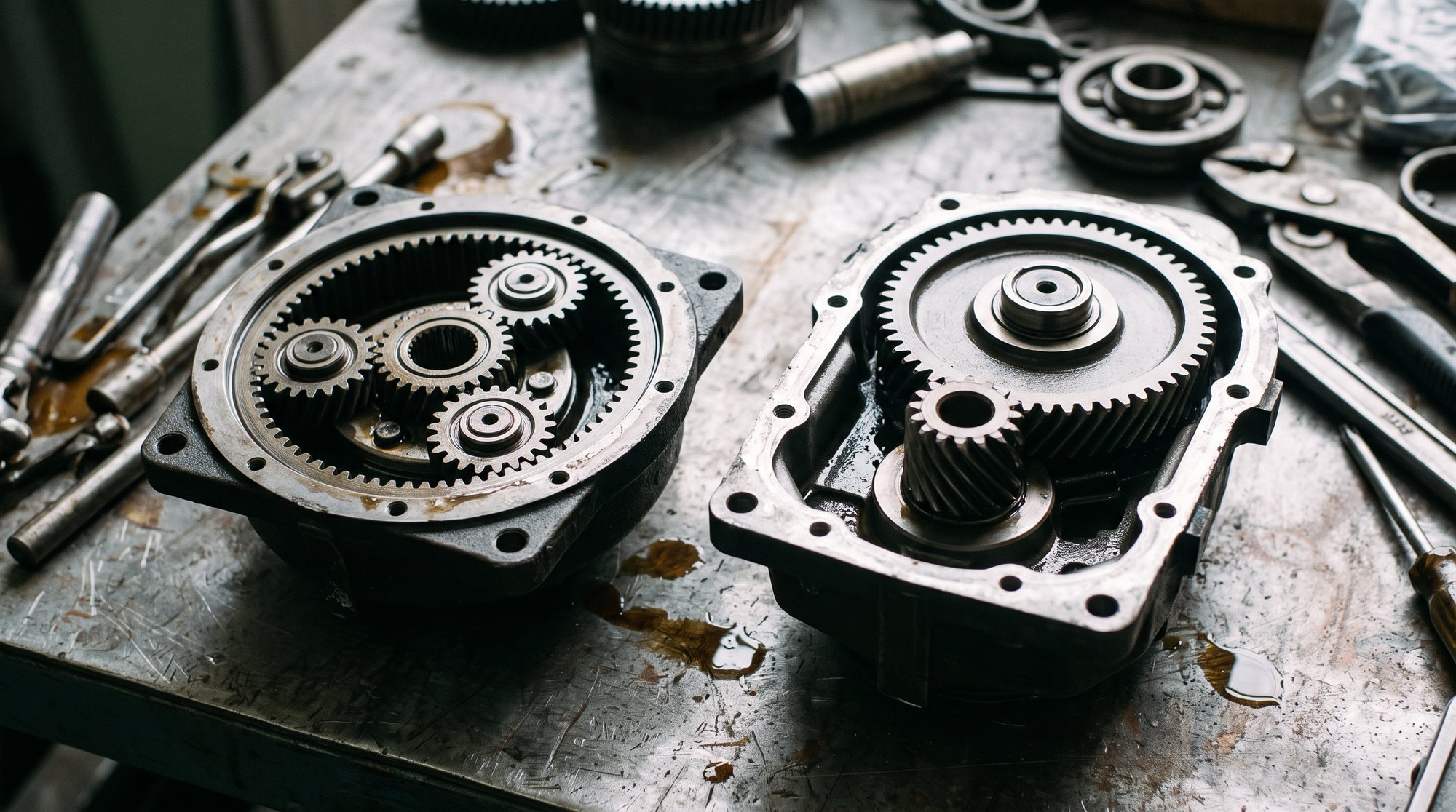
In a helical (spur-type) gearbox, cylindrical gears with parallel axes mesh with each other. A small pinion drives a larger wheel. The ratio of the numbers of teeth gives the transmission ratio. For higher reductions, several stages are connected in series.
The teeth are either straight (spur) or helical. Helical gears run more quietly and carry more load, but they generate axial forces that the bearings have to absorb. Industrial helical gearboxes come in various designs:
- Inline helical gearboxes: input and output shafts are in line, typical of the classic helical geared motor.
- Parallel shaft gearboxes: offset parallel shafts, often with a hollow shaft for mounting directly onto the machine shaft.
- Helical bevel gearboxes: a bevel gear stage turns the drive through 90 degrees, followed by helical stages.
- Industrial gear units: large, multi-stage helical gearboxes for mills, conveyor systems or extruders.
How a planetary gearbox works
A planetary gearbox has a coaxial design and consists of four basic elements:
- Sun gear: the central gear, usually driven by the motor.
- Planet gears: several gears that orbit the sun gear, often three or four.
- Ring gear: an internally toothed ring in which the planets roll, fixed in the standard arrangement.
- Planet carrier: holds the planets and usually forms the output.
How a planetary gearbox works in practice: when the sun gear turns and the ring gear is fixed, the planets travel round inside the ring gear and slowly take the planet carrier with them. The ratio is then derived from the numbers of teeth: i = 1 + teeth on ring gear / teeth on sun gear. Fictitious worked example: a ring gear with 72 teeth and a sun gear with 24 teeth give i = 1 + 72/24 = 4. A motor running at 1,400 rpm then drives the output at 350 rpm.
The crucial point: the load is shared between several planets at the same time. Several tooth meshes split the torque. That makes planetary gearboxes more compact than a comparable helical gearbox for the same power.
Planetary gearbox or helical gearbox: the comparison
| Criterion | Planetary gearbox | Helical gearbox |
|---|---|---|
| Construction | coaxial; sun gear, planets, ring gear, carrier | parallel axes, one or more gear pairs |
| Torque per frame size | high, load shared across several planets | lower; larger and heavier for the same torque |
| Ratio per stage | relatively high | lower; several stages for high reduction |
| Backlash | very low in precision versions | usually higher, rarely first choice for positioning tasks |
| Efficiency | high | high |
| Construction and maintenance | more complex, more components in a tight space | simple, easily accessible, robust |
| Typical applications | servo axes, robotics, wind power, construction machinery, heavy drives in tight spaces | conveyor systems, pumps, agitators, fans, general mechanical engineering |
Planetary gearbox: the advantages in detail
The main advantages of a planetary gearbox at a glance:
- High power density: a lot of torque in a small space and with low weight.
- Coaxial design: motor, gearbox and output are in line. This makes mounting easier.
- Low backlash: precision planetary gearboxes for servo motors are offered with very low backlash, specified in arc minutes (arcmin). This matters for positioning tasks.
- High torsional stiffness in precision versions, good for dynamic axes.
- Symmetrical load distribution: the planets balance each other out, which relieves the bearings.
The downside: planetary gearboxes are more complex to manufacture. Internal damage is usually harder to fix on site than with a helical gearbox. Heat dissipation is an issue because of the compact design; for continuous operation under high load, the thermal power limit must be observed.
Helical gearbox: the advantages in detail
- Simple and robust: few, easily accessible components, proven technology.
- Cost-effective: the cheaper solution for many standard drives.
- Good heat dissipation thanks to the larger housing.
- Wide choice: helical geared motors are on the market in many sizes, ratios and mounting types.
- Easy to maintain: bearings, seals and oil are usually simple to change.
The limits: for high torques, a helical gearbox becomes large and heavy. For highly dynamic servo axes with demanding positioning accuracy, a planetary gearbox is generally the better fit.
When each gearbox pays off
A planetary gearbox is usually the better choice if …
- space is limited but high torques are still needed,
- a servo motor has to position an axis precisely,
- weight matters, for instance on moving axes or robots,
- a coaxial arrangement is essential.
A helical gearbox is usually the better choice if …
- it is a conventional drive with an induction motor, such as conveyor belts, pumps or agitators,
- space is available and robustness and ease of maintenance come first,
- the drive runs continuously and heat dissipation is important,
- a hollow shaft for shaft mounting is needed, as with many parallel shaft gearboxes.
The load capacity of cylindrical gears, including the gears in a planetary gearbox, is calculated to ISO 6336. More important for the user is the service factor specified by the gearbox manufacturer. It takes into account shocks, switching frequency and daily running time. A gearbox designed for uniform operation can be undersized for shock loads.
Replacing a gearbox: the typical pitfalls
When replacing a gearbox, don’t just look at power and ratio. In practice, the swap often falls down on details:
- Ratio not exact: gearboxes often have odd ratios such as 28.57 rather than 28. Even small deviations change the belt speed or the cycle rate of a line.
- Output shaft doesn’t fit: solid shaft or hollow shaft, diameter, key or shrink disc must match the machine.
- Different mounting: foot-mounted, flange or torque arm, plus hole pattern and shaft height.
- Motor mounting unclear: is the gearbox supplied with a motor or fitted to an existing one? Then flange and shaft connection must match, and with servo motors the adapter too.
- Mounting position forgotten: the oil quantity and the position of the breather and oil drain depend on the mounting position.
- Radial load underestimated: a sprocket or pulley on the output loads the output bearings. The permissible value is in the manufacturer’s catalogue.
Typical scenario: planetary instead of helical
A helical geared motor on a lifting drive is to be replaced with a planetary gearbox because one is available. Ratio and torque match. Even so, a review is needed: shaft height, mounting, output shaft and permissible radial load differ, and the motor has to be refitted. It usually can’t be done without modifying the machine. Such a change is a technical modification, not a simple spare parts solution.
Maintenance: how to spot gearbox damage early
Whether planetary gearbox or helical gearbox: most damage gives advance warning. If you look and listen regularly, you can plan the replacement instead of having to deal with it during downtime. Watch out in particular for these signs:
- Noise: a new whine, knock or grinding indicates wear on the gearing or bearings.
- Temperature: a housing that gets noticeably hotter than usual points to lubrication problems or overload.
- Oil condition: metal particles, discolouration or foam in the oil are warning signs. An oil sample provides clarity.
- Leakage: oil escaping at the shaft seals lowers the oil level and puts bearings and gearing at risk.
- Play at the output: if backlash grows noticeably, the gearing is worn. On servo axes this often shows up first as positioning errors.
Stick to the manufacturer’s oil change intervals and lubricant specifications. The wrong oil can damage a gearbox faster than a high load.
What to specify when ordering a replacement
For a fast, accurate enquiry, have these details from the nameplate of the gearbox or geared motor ready:
- manufacturer and complete type designation
- serial number, so that special versions can be traced
- exact ratio i and output speed
- output torque and service factor
- mounting position and mounting type (foot, flange, shaft-mounted)
- output shaft: solid or hollow, diameter, fastening
- motor data, if it is a geared motor: power, voltage, frequency, brake, encoder
- lubricant specification from the nameplate
- photos of the nameplate, output side and mounting
If the nameplate is illegible, dimensions, photos and the application help. Our checklist for spare parts enquiries shows which details generally count. To learn how bearing damage in a gearbox announces itself, read the article Ball bearing failing? 7 signs of bearing failure.
When the gearbox is hard to get
On older drives, the original gearbox is sometimes discontinued or hard to obtain. KTB Europe is a family business from Hamburg and has been sourcing industrial spare parts of all brands worldwide since 1976. You can send us the part number, a photo of the nameplate or a description. If the original is no longer available, we look for successor types or equivalent alternatives that you can technically review and approve.
Find out more on our pages on MRO procurement and discontinued parts. You can send your enquiry directly via the contact page.
Conclusion
Planetary gearboxes deliver a lot of torque in a small space and, in precision versions, are suited to servo axes. Helical gearboxes are simple, robust and the obvious choice for many standard drives. When replacing, it isn’t only power and ratio that count, but also output shaft, mounting, mounting position and radial load. Changing the gearbox type is possible, but it is a technical modification that should be reviewed beforehand.
Frequently asked questions
How does a planetary gearbox work?
A central sun gear drives several planet gears that roll inside an internally toothed ring gear. With the ring gear fixed, the planets take the planet carrier with them, which forms the slow output. Because the load is shared across several planets, the gearbox is very compact.
What are the advantages of a planetary gearbox over a helical gearbox?
For the same frame size, planetary gearboxes transmit more torque, are coaxial and lighter. In precision versions they have very low backlash, which makes them suitable for servo axes. Helical gearboxes, on the other hand, are simpler, more robust and often more economical.
Where are helical gearboxes typically used?
You will find helical gearboxes mainly in conventional drives with an induction motor, such as conveyor belts, pumps, agitators and fans. They are robust, easy to maintain and available in many sizes and designs, including parallel shaft gearboxes with a hollow shaft.
Can I replace a helical gearbox with a planetary gearbox?
Technically this is often possible, but it is not a simple like-for-like swap. Ratio, output torque, output shaft, mounting, shaft height and permissible radial load must all match. Modifications to the machine are usually needed, so the change should be technically reviewed and documented.
Which nameplate data do I need for a replacement gearbox?
Key details are manufacturer, complete type designation, serial number, exact ratio, output speed and torque, service factor, mounting position and mounting type. For geared motors, add the motor data. Photos of the nameplate, output shaft and mounting also help.
About the author
Mica Duarte
Senior Procurement Specialist at KTB Europe with over 15 years of experience in global MRO sourcing and supply chain management.
LinkedIn