
7 min read
Friday, just after 10 pm. A packaging line is down: an interface relay in the control cabinet has burnt out. A component that barely stands out in the catalogue. There’s none in stock, so the electrician improvises by taking one out of a decommissioned machine. The line is running again, but only through luck.
Nights like this are rarely caused by large, expensive components. They are caused by small parts nobody thought of. A control cabinet contains dozens of components, and almost any one of them can bring a machine to a standstill.
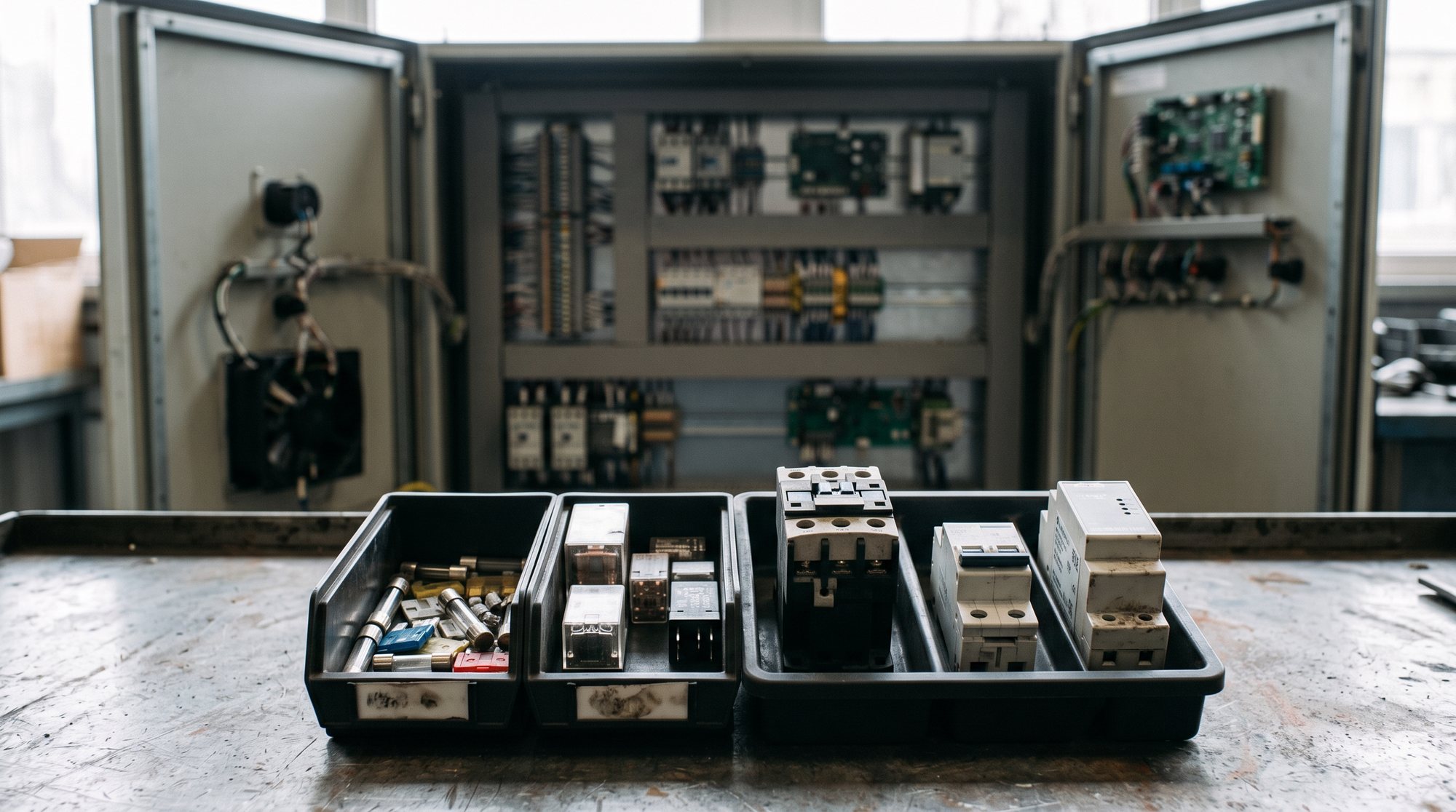
This checklist shows ten spare parts that, in many plants, should never be missing from a control cabinet spares store. You will also learn why they are critical, which data you need to stock them and how to tailor the list to your own equipment.
Safety note: work on electrical installations may only be carried out by qualified electricians or by electrically instructed persons under the supervision of a qualified electrician, in line with the German accident prevention regulation for electrical installations (DGUV Vorschrift 3) and the standard on operating electrical installations (DIN VDE 0105-100). The manufacturers’ instructions and the plant documentation always take precedence.
Why control cabinet components in particular?
Control cabinet components have three characteristics that make them worth stocking. First, they are often small and comparatively cheap, yet a failure stops the entire machine. Second, many of them are wear parts, such as contacts, fans or batteries. Third, the same types often recur across several machines. One part in stock then covers several machines at once.
When choosing, remember: the right list depends on your equipment. The following ten items are a proven starting point, not a substitute for a criticality assessment.
The 10 spare parts at a glance
1. Fuse links and miniature circuit breakers
Fuses exist to blow. That’s why you need replacements, and in exactly the right version: type (for example NH/NH blade, D/DO, miniature fuse or cylindrical fuse), rated current, utilisation category such as gG or aM, and breaking capacity. For miniature circuit breakers (MCBs), what counts is the tripping characteristic (B, C, D), rated current and number of poles. A wrong fuse is worse than none, because it defeats the protection of the cable or device.
2. Contactors and auxiliary contact blocks
Contactors switch motors, heaters and other loads. Their main contacts wear with every operation, especially with frequent inching. For a replacement, what counts is rated operational current or power in the right utilisation category (such as AC-3 to IEC/EN 60947-4-1), coil voltage including AC or DC (for example 24 V DC or 230 V AC) and the auxiliary contacts. If you want to understand the difference between a contactor and a relay, read the article Contactor or relay? The difference simply explained.
3. Motor protection circuit breakers and overload relays
They protect motors against overload and short circuit. If a device fails, the replacement must have the right setting range so that the motor’s rated current can be set correctly. Note the set value for every installation location. How to choose it correctly is explained in How to set a motor protection circuit breaker correctly.
4. Interface relays and plug-in relays with sockets
Interface relays isolate the controller from the load and amplify signals. They are often mounted side by side in large numbers. Plug-in relays in particular can be swapped quickly if a suitable replacement is to hand. Coil voltage, contact type and number, switching capacity and socket design are what matter. Keep a few relays and at least one socket per type in stock.
5. Safety relays
Safety relays monitor emergency stop buttons, guard doors or light curtains. Without a working safety relay the machine must not run, and bypassing is strictly off limits. A replacement must exactly match the installed type or be approved by the person responsible for safety, because the safety function has been assessed to EN ISO 13849-1. After the swap, a documented functional test of the safety circuits is mandatory. Also check whether settings such as release delay or start mode have to be set on the device.
6. 24 V power supplies
Almost every control system depends on a 24 V DC power supply. If it fails, the controller, sensors and valves all lose power at once. Power supplies age, among other things, because heat degrades their electrolytic capacitors. For a replacement, what counts is input voltage, output current, DIN rail format and possibly functions such as parallel operation or signalling contacts.
7. PLC I/O modules and bus couplers
Input and output modules are the interface to the machine. Short circuits in the field wiring or overvoltages damage them first. Keep at least one module of each of the most common types in stock, especially digital outputs. With older controller generations this becomes an obsolescence issue, as the article Siemens S7-300 discontinued shows.
8. Controller memory card and backup battery
Many controllers and operator panels work with memory cards; some use a backup battery for data or the real-time clock. A memory card with the current program version and a spare battery are small parts with a big impact. Even more important is an up-to-date backup of the program, stored separately from the machine. Without it, even the best spare CPU is of little use.
9. Enclosure fans and filter mats
Heat is one of the main reasons electronic components fail. Filter fans wear in their bearings, filter mats clog. A failed fan often only gets noticed when the frequency inverter trips on overtemperature. Filter mats are classic consumables and belong in the maintenance plan; fans belong in the store as reserves.
10. Control and signalling devices
Push buttons, selector switches, indicator lights and emergency stop devices are operated every day and wear mechanically. Often it is enough to replace the contact block or the LED element rather than the whole device. So stock the common contact and LED elements as well as some front elements in the colours used on your machines.
The checklist as a table
| Spare part | Why it is critical | Key data for the replacement |
|---|---|---|
| Fuse links, MCBs | designed to trip | type, rated current, utilisation category or characteristic, breaking capacity |
| Contactors, auxiliary contacts | contact wear | utilisation category, rated current, coil voltage, auxiliary contacts |
| Motor protection circuit breakers, overload relays | failure stops the motor | setting range, set value, short-circuit release |
| Interface relays with sockets | many installation points, frequent failures | coil voltage, contacts, switching capacity, socket |
| Safety relays | machine must not run without one | exact type, configuration, approval |
| 24 V power supply | powers the entire control system | input voltage, output current, format |
| I/O modules, bus couplers | damage from field faults | complete part number, firmware version |
| Memory card, backup battery | loss of program and data | card type and size, battery type, current backup |
| Fans, filter mats | overheating of electronics | size, voltage, airflow, filter class |
| Control and signalling devices | mechanical wear | diameter, contact or LED element, colour, voltage |
How to adapt the list to your equipment
A general list is a start. It only becomes truly effective once you compare it with your circuit diagrams and bills of materials. This approach has proven itself:
- Record what you have: evaluate the bills of materials for the control cabinets or record the nameplates on site.
- Find common parts: which types occur in several machines? Stock these first.
- Assess criticality: what happens if the part fails? A whole line down or just a secondary function?
- Check replenishment: is the part available at short notice, or has it been discontinued?
- Set a minimum stock level and label it clearly in the store, with installation location and part number.
- Review regularly: update the list after every modification and every discontinuation notice.
Classifying spare parts systematically by criticality and setting minimum stock levels is the job of spare parts management. Support with this is available through our services for spare parts management.
Typical stocking mistakes
- Wrong coil voltage: the contactor is in stock, but with 230 V AC instead of 24 V DC.
- Socket forgotten: the relay is there, the matching socket is not.
- Old firmware version ignored: a newer module behaves differently or isn’t accepted by the controller.
- Storage without care: batteries age on the shelf too. Pay attention to the date of manufacture and storage conditions.
- No documentation: at 2 am, nobody knows which part goes into which cabinet.
Storing correctly: so the spare part works when it matters
A spare part only helps if it can be found quickly in an emergency and is in perfect condition. Store electronic modules dry, dust-free and in their original packaging, and modules with sensitive electronics additionally in ESD-safe packaging. Note the part number, product version and the machines in which the part is installed at the storage location.
A dedicated compartment per cabinet type or machine has proven its worth, supplemented by an overview list in the maintenance system. When a part is taken out, a reorder is triggered immediately. Otherwise, at the second failure, nobody will have a replacement ready again.
What to include in your enquiry
For fast procurement of control cabinet components, you mainly need: manufacturer, complete part number, a photo of the nameplate or device labelling, the firmware or product version for controller modules, and the quantity required. If an alternative is acceptable, say who will approve it technically. More on this in the checklist for spare parts enquiries.
When parts are hard to get
Many control cabinet components are standard goods. On older machines, however, it is precisely controller modules, safety relays or special versions that have been discontinued. KTB Europe, a family business from Hamburg, has been sourcing spare parts of all brands worldwide since 1976. You send us the part number, a nameplate photo or a description; we find the part or a suitable alternative and inspect it in our own central warehouse. More under MRO procurement. You can send your enquiry via the contact page.
Conclusion
Most control cabinet downtime is caused by small, inconspicuous parts. Ten items, from the fuse to the indicator light, cover a large share of typical failures. The key is to match the list against your equipment, make use of common parts, record coil voltages and firmware versions precisely and keep an up-to-date program backup to hand. Then the next night shift becomes a quick swap instead of an improvisation.
Frequently asked questions
Which spare parts should you keep in stock for the control cabinet?
Proven items are fuse links, miniature circuit breakers, contactors, motor protection circuit breakers, interface relays with sockets, safety relays, 24 V power supplies, I/O modules, the controller’s memory card and backup battery, fans with filter mats, and contact and LED elements. Check the exact list against your bills of materials and the criticality of your equipment.
What do I need to consider when replacing a safety relay?
The replacement must match the installed type or be approved by the person responsible for safety, because the safety function has been assessed. Settings on the device must be carried over. After the swap, a documented functional test of all connected safety circuits is required.
Which components belong in a control cabinet?
Typical control cabinet components are the incoming supply and main switch, fuses and miniature circuit breakers, contactors, motor protection circuit breakers, relays, power supplies, the controller with input and output modules, frequency inverters, terminals and fans or cooling units. The design depends on the machine and the requirements of the EN 61439 series.
How do I decide how many spare parts to stock?
What matters is the impact of a failure, the number of identical parts in your equipment, the failure frequency and the replenishment lead time. Parts that can stop several machines and are hard to obtain deserve a higher minimum stock. Review the list regularly after modifications and discontinuations.
Why does the coil voltage of a contactor have to be exactly right?
A contactor’s coil is designed for a specific voltage and type of current, such as 24 V DC or 230 V AC. A contactor with the wrong coil will not pull in or will be damaged. That is why the coil voltage, alongside the rated current, is one of the most important details when stocking spares.
About the author
Mica Duarte
Senior Procurement Specialist at KTB Europe with over 15 years of experience in global MRO sourcing and supply chain management.
LinkedIn