
6 min read
In cement plants, refineries, petrochemical plants and power stations in the Gulf region, there is one date that sets the maintenance calendar: the turnaround. For a few weeks the plant stands still. Hundreds of jobs are done in parallel: inspections, repairs, replacement of wear parts, modernisations. Every day of shutdown costs production. Every day of overrun costs more.
Whether a turnaround stays on schedule is largely decided long before the first spanner is turned: in spare parts planning.
What is a turnaround?
A turnaround, also called a shutdown or major outage, is a planned, full or partial shutdown of a plant for extensive maintenance work. It takes place at fixed intervals, annually or in longer cycles depending on the plant and mode of operation. In the process industry it is often the only time certain components are accessible at all.
For spare parts procurement this means: there is a fixed date, a long list and no leeway. Whatever is not there at the start may be missing until the next turnaround.
A turnaround forgives a lot, but not a missing part on day one.
What makes the Gulf region special
Climate
High temperatures, dust, sand and, near the coast, salt-laden air put more strain on plants than in temperate zones. Seals age faster, filters clog sooner, bearings and electronics suffer from heat and particles. Spare parts must be suitable for these conditions. Storage on site also needs attention: elastomers and electronics should not sit in uncooled containers in the sun.
International plants
Many plants in the region were built by international general contractors. The components come from Europe, North America and Asia. The range of manufacturers is correspondingly broad, and the routes for original parts correspondingly long.
Conformity and documents
Imports into countries in the region are subject to their own requirements. In Saudi Arabia, for example, many products have to be registered via the SABER conformity platform. Certificates of origin and commercial invoices must follow specific rules. If you only clarify these requirements shortly before the turnaround, you risk parts getting stuck in clearance.
Local value creation
Several Gulf states specifically promote local value creation and local suppliers. For buyers this can mean that local partners are preferred or that certain shares should be sourced locally. This affects the choice of suppliers, not the technical quality of the parts.
Why turnarounds overrun
The causes of extended shutdowns are similar in many plants. It is rarely a lack of manpower. More often parts are missing because the work list was finalised too late, because lead times were underestimated, because a part was stuck in clearance or because a part from stock turned out to be unusable. Each of these causes can be significantly reduced through early and systematic planning.
Spare parts planning in five phases
Phase 1: define the scope
The turnaround work list is the basis. Every job results in a material requirement: gaskets for flange connections, bearings for drives, wear parts for mills and crushers, valves, pump parts, filter bags, refractory material. The earlier the work list is fixed, the earlier you can order.
Phase 2: identify long-lead items
Some parts have lead times of many months. Typical examples are large gearboxes, special pumps, rollers, special valves or control components with discontinued status. These parts must be identified and ordered first, often long before the rest of the list is complete.
Phase 3: reconcile stock
What is already in the plant store? In what condition? Does it still match the current version of the plant? Parts that have been in stock for years should be checked before the turnaround. Nothing is more annoying than a stock part that turns out to be wrong or aged during installation.
Phase 4: procure and bundle
Orders go to many manufacturers in many countries. To keep track, it pays to bundle procurement: fewer contacts, joint expediting, coordinated documents. For the Gulf region it is also important that deliveries arrive with enough buffer before the turnaround to allow for inspection, clearance and transport to the plant.
Phase 5: inspect and stage
Before the turnaround, every part should be checked for type, quantity and condition and assigned to the right work package. Clear labelling saves the fitters from searching. Find out more about how we handle the inspection of sourced parts on our inspection.
Example: cement plant
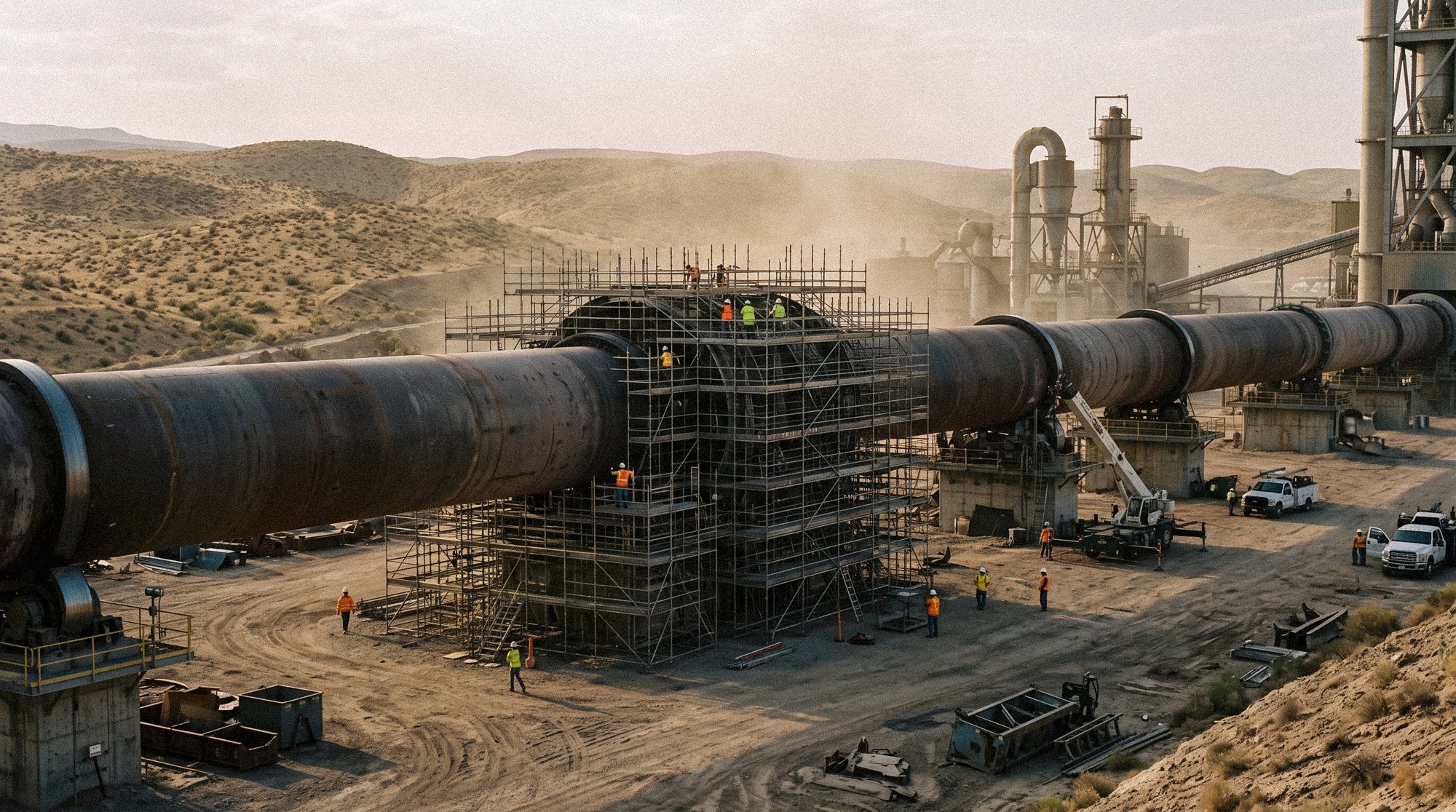
Cement plants are among the large industrial facilities in the Gulf region. Their heart, the rotary kiln, runs without interruption wherever possible. During a shutdown the following are typically worked on:
- Kiln and cooler: refractory lining, seals at the kiln inlet and outlet, cooler grates and drives
- Mills: grinding rollers, grinding tables, liner plates, gearboxes and bearings
- Filters: filter bags, support cages, cleaning valves
- Conveying: belts, idlers, bucket elevator chains, couplings
- Electrical and automation: drives, sensors, control components
Many of these parts are wear parts with known replacement cycles. They can be planned well in advance. The challenge lies in the parts whose condition only becomes visible during inspection. For these you need either reserve stock or a fast sourcing channel during the turnaround.
Typical scenario: the inspection on day three
A plant starts its turnaround on schedule. On day three, inspection of a gearbox reveals unexpected damage to a bearing. The bearing is not a standard part. There is no replacement in stock. Now every hour counts: manufacturer, part number, dimensions, everything has to go out immediately to potential suppliers, in parallel in Europe, Asia and America. A plant that has a fixed sourcing partner with an international network for such cases has a clear advantage over a plant that only now has to look for suppliers.
Who belongs on the turnaround team?
Spare parts planning for a turnaround is teamwork. Typical roles are:
- Turnaround manager: responsible for scope, schedule and budget.
- Maintenance planner: translates jobs into material requirements.
- Procurement: sources, expedites and clarifies terms.
- Stores and goods receipt: inspect, label and stage parts.
- External partners: support with hard-to-find and international parts.
What matters is a shared list that everyone can access and that shows the status of every part: enquired, ordered, delivered, inspected, staged.
After the turnaround is before the turnaround
The best time to prepare the next turnaround is right after the last one. Record which parts were missing, which arrived too late and what surprises there were. Update the list of long-lead items and check which reserve parts were used and need to be procured again. This review takes a few days and significantly improves the next round of planning.
Checklist for turnaround spare parts planning
- Work list fixed early and translated into material requirements
- Long-lead items identified and ordered first
- Plant store checked for stock, condition and fit
- Climate-suitable versions and storage conditions taken into account
- Import and conformity requirements clarified early
- Buffer planned between delivery and the start of the turnaround
- Parts inspected, labelled and assigned to work packages
- Fast sourcing channel for surprises during the shutdown
KTB and the Gulf region
Since 1976 KTB has been sourcing spare parts for industrial customers worldwide, including cement plants and the process industry. In the region KTB is represented by an office in Riyadh. From our head office in Hamburg we source across manufacturers from suppliers in Europe, America and Asia and inspect the goods in our central warehouse.
Find out more about our approach on the procurement and spare parts management.
Conclusion
A turnaround is a project with a fixed end date. In the Gulf region, climate, international plants and import requirements increase the pressure on spare parts planning. If you plan early, tackle long-lead items first, check stock and have a fast route for surprises, you keep the shutdown on schedule.
Are you preparing a turnaround? Send us your spare parts list via our contact page.
Frequently asked questions
What is a turnaround in industry?
A turnaround, also called a shutdown or major outage, is a planned shutdown of an industrial plant for extensive maintenance work. Inspections, repairs, replacement of wear parts and modernisations are bundled into a fixed time window. Turnarounds are common in the process industry, refineries, power stations and cement plants and are often prepared over months.
When should you order spare parts for a turnaround?
As early as possible. Parts with long lead times, known as long-lead items, such as large gearboxes, special pumps or special valves, often need to be ordered many months in advance. For the rest of the list: the parts should arrive with enough buffer before the start to safely allow for inspection, clearance and transport to the plant.
What should you pay particular attention to with spare parts for the Gulf region?
Heat, dust and salt-laden air put more strain on plants and stored parts. Spare parts and storage conditions should be designed for this. On top of this come import and conformity requirements, such as registration via SABER in Saudi Arabia, as well as rules on certificates of origin and commercial invoices. These points should be clarified well before the turnaround.
How do you deal with unexpected damage during a turnaround?
For parts whose condition only becomes visible during inspection, you need either reserve stock or a fast sourcing channel. Prepare complete part data and work with a partner who can send enquiries to suppliers in several regions in parallel. This shortens the search when every hour counts.
About the author
Mica Duarte
Senior Procurement Specialist at KTB Europe with over 15 years of experience in global MRO sourcing and supply chain management.
LinkedIn